Clearance CLR-4117 · AIR378
AIRALA
Airlines & NetworksClearance sheet
Alaska Airlines to Retire 737-700 Fleet by Next Year
Alaska Airlines will retire its Boeing 737-700 fleet by next year, citing added cargo capacity as the fleet consolidates around larger 737 variants.
Read-back
- Alaska Airlines will retire its Boeing 737-700 fleet by next year.
- The carrier cites increased cargo capacity as a driver of the withdrawal.
- The retirement consolidates Alaska's fleet around larger 737-family variants.
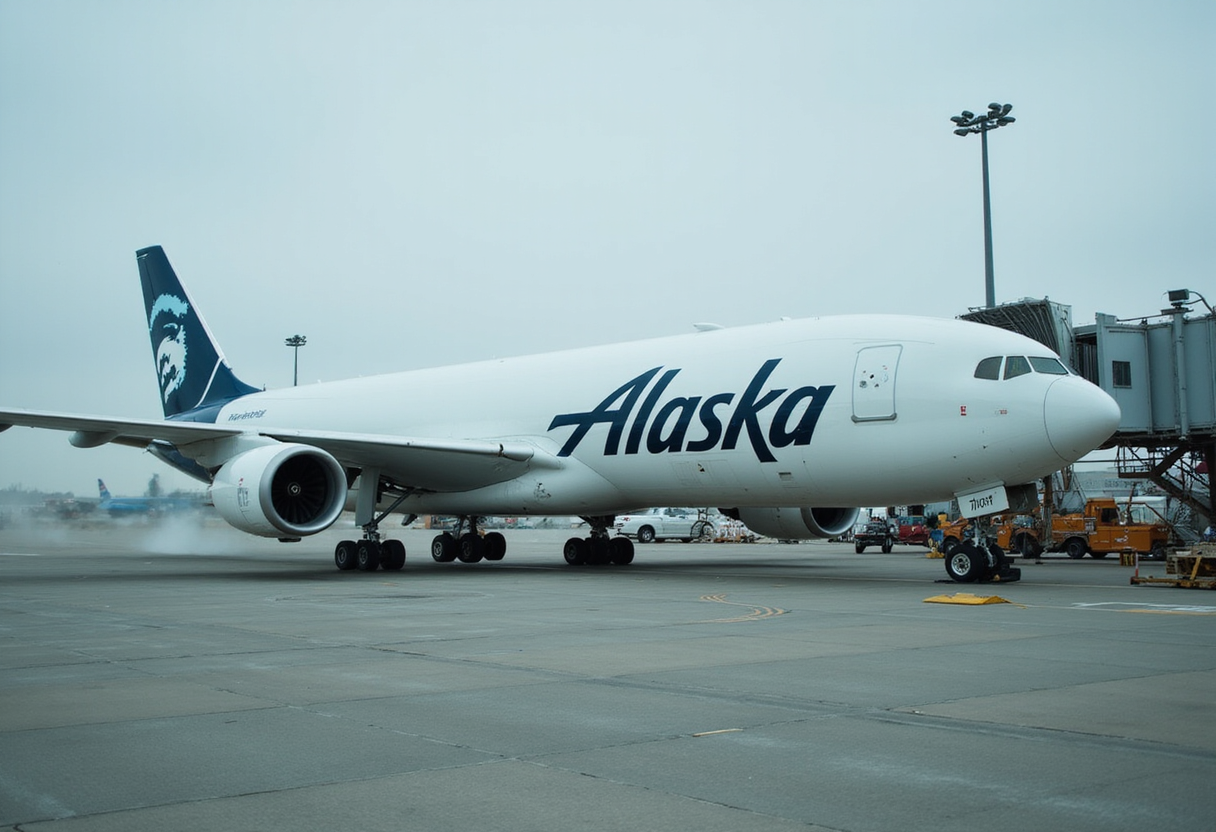
Alaska Airlines will retire its Boeing 737-700 fleet by next year, a withdrawal the carrier links directly to expanding cargo capacity across its network.
The decision removes the smallest variant of the 737 family from Alaska's passenger fleet and concentrates flying on larger narrowbody types. For a carrier whose network spans transcontinental routes and thin West Coast markets, the move signals that belly capacity and cargo revenue now carry real weight in fleet planning.
Why retire the -700 now?
The 737-700 sits at the bottom of Boeing's narrowbody size ladder. Airlines across the industry have been trading down-cycle: fewer frequencies on larger aircraft, or in Alaska's case, standardizing on the 737-800, 737-900ER and the 737 MAX family as those aircraft deliver.
Every -700 that exits frees a slot — in crew planning, maintenance slots and airport gates — that a larger airframe can fill. The cargo argument compounds this. Larger variants carry more belly volume on the same flight, on the same crew cost, burning marginally more fuel per trip but moving substantially more payload.
Alaska framed the retirement explicitly around freight: pulling the -700s adds cargo capacity across the operation. That framing matters for a market where e-commerce traffic has pushed belly-freight yields upward and where dedicated freighter capacity on intra-West Coast lanes remains thin.
What changes for the network?
The practical consequences fall into three buckets:
- Cargo: more lower-deck volume per departure as larger types replace -700 missions.
- Fleet commonality: one fewer sub-type to manage for spares, maintenance planning and crew qualification within the 737 family.
- Seat economics: higher seat count per departure, which supports unit-cost performance on routes that can absorb the capacity.
The risk sits on the demand side. The -700's smaller cabin suits thin routes and airports with operational constraints. If Alaska up-gauges those markets, some frequencies or marginal stations could come under review — a standard consequence of fleet consolidation that network planners weigh against the unit-cost gain.
Alaska has been here before. The carrier has run successive fleet simplification programs over the past decade, consolidating around Boeing narrowbodies after retiring other types. Each round traded fleet flexibility for scale economics, and each round leaned on the assumption that the network could absorb the added seats and belly space. The cargo market of the past several years has made that assumption easier to defend.
The cargo angle
Alaska's own justification — "more cargo capacity" — is the most concrete signal in the announcement. Belly freight has become a meaningful revenue line for US carriers, and fleet decisions increasingly reflect it. A -700 offers the least lower-deck volume of the carrier's 737 variants; replacing it with -800-class aircraft or MAX-family jets raises freight capacity on every affected rotation without adding flights.
For shippers and freight forwarders on Alaska's network, particularly into and out of Seattle and other West Coast gateways, the shift should translate into more reliable belly space over time. The transition's pace will determine how quickly that capacity arrives; retirements phased through next year suggest the cargo benefit builds gradually rather than overnight.
What to watch
The retirement timeline — complete by next year — gives observers a clean checkpoint. Watch three things: the rate at which -700s actually exit the fleet against that schedule, which Alaska markets see frequency adjustments as up-gauging proceeds, and whether the freed capacity flows to cargo growth or simply to larger passenger loads.
Manufacturer delivery performance will shape the back end of the transition. If replacement aircraft arrive late, Alaska faces the familiar choice between extending -700 operations or cutting capacity. If deliveries hold, the carrier exits the type on schedule and banks the simplification and cargo benefits.
By this time next year, the -700 should be out of Alaska's fleet — and the carrier's belly-freight capacity will show whether the promise of "more cargo" translated into flown tonnage.
via Google News: Air cargo (Source)
More from Sophie Lindqvist
Show full bio
Senior reporter covering industry trends and analytics at Flightdeck Report.
411 articles
Same bay
- FDR691Alaska Air Cargo to expand 737 freighter fleet to nine aircraft · September 27, 2026
- FDR585Alaska Airlines Places Largest Aircraft Order in Its History With Boeing · October 10, 2026
- FDR113Alaska Airlines orders 110 Boeing jets, led by 105 737 MAX 10s · October 9, 2026
- FDR872Alaska Airlines commits to largest-ever Boeing order in its history · October 10, 2026
- FDR768Alaska Orders 105 737-10s and Five 787s in Largest-Ever Fleet Deal · September 30, 2026