Clearance CLR-1749 · AIR560
AIRBYE
Aircraft & EnginesClearance sheet
Bye Aerospace's eFlyer 2 Trainer Makes First Flight in Colorado
Bye Aerospace flew its all-electric eFlyer 2 trainer at Centennial Airport, launching flight tests toward FAA certification with an orderbook topping 1,000 aircraft.
Read-back
- The all-electric eFlyer 2 made its first flight on September 24, 2026, at Centennial Airport near Denver, flown by Chief Test Pilot Elliot Seguin.
- The FAA granted Bye Aerospace a Special Airworthiness Certificate for the eFlyer 2 earlier in September 2026, enabling flight testing.
- The orderbook for the two-seat eFlyer 2 and four-seat eFlyer 4 exceeds 1,000 aircraft, with buyers including Spartan College, Skyborne Academy, Flex Air and KLM Academy.
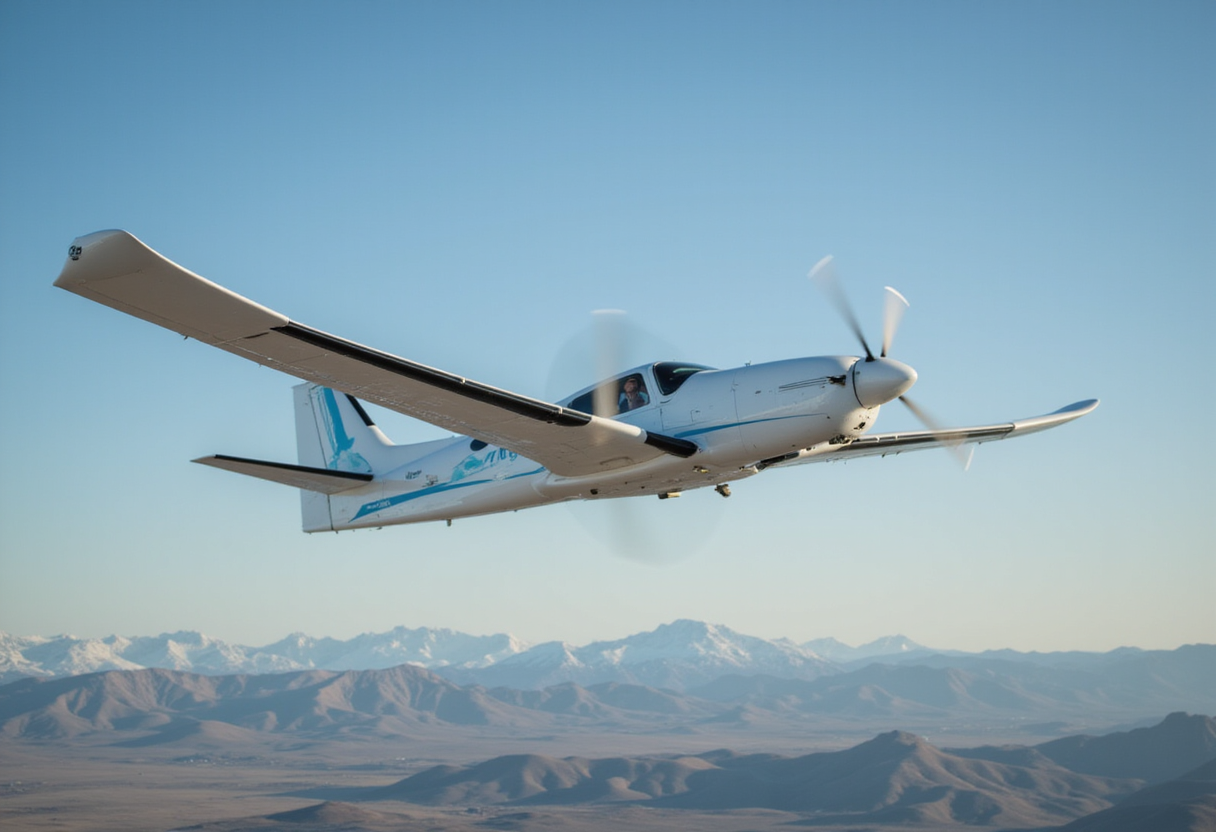
Bye Aerospace's all-electric eFlyer 2 trainer has completed its first flight, opening the flight test campaign for an aircraft that anchors an orderbook of more than 1,000 units across the company's two-seat and four-seat models.
Chief Test Pilot Elliot Seguin flew the aircraft from Centennial Airport (APA) near Denver, Colorado, on September 24, 2026. The sortie, announced the same day, covered initial evaluation of handling qualities, aerodynamic characteristics and system performance, with data collected to support the next phase of flight testing.
"First flights are always significant moments for any new aircraft program. This team has worked hard and they will remember this achievement for a long time," Seguin said. "The eFlyer 2 handled well during the flight and validated the work the engineering team has put into designing and testing the aircraft over the past several years."
The flight marks the formal start of the eFlyer 2's certification campaign toward Federal Aviation Administration approval and, ultimately, customer deliveries. Earlier in September, the FAA granted Bye Aerospace a Special Airworthiness Certificate for the aircraft — the regulatory step that cleared the way for test operations.
Performance claims against backlog
Bye Aerospace claims the eFlyer 2 can cut operating costs by up to 80% compared with conventional trainers while eliminating in-flight emissions, thanks to an electric propulsion system and a lightweight composite airframe that the company describes as safety-focused. As with all manufacturer economics claims, those figures remain to be demonstrated across a certified fleet in daily flight school operations rather than in a single test sortie.
What is verifiable today is demand. The combined orderbook for the two-seat eFlyer 2 and the four-seat eFlyer 4 exceeds 1,000 aircraft. Named buyers include Spartan College of Aeronautics & Technology, Skyborne Academy, Flex Air Flight School and KLM Academy in the Netherlands — a customer base spanning US professional pilot training and a European airline-affiliated academy.
"The first flight of eFlyer 2 exceeded all of our expectations in terms of aerodynamics, handling, propulsion and overall performance—and there were no maintenance discrepancies during the flight," Rod Zastrow, CEO of Bye Aerospace, said. "This program is an important step in demonstrating that electric aircraft can deliver disruptive operational cost advantages while maintaining the performance, safety, and handling qualities required for real world training environments."
Zastrow called the flight a milestone for electric aviation that could help "reduce the oftentimes prohibitive costs of flight training." The company also argues the aircraft lets operators "break free from high and uncertain fossil fuel prices, and crippling engine overhaul backlogs" — a direct pitch at the two largest variable costs in the training segment: avgas and piston engine maintenance.
Supplier base
The program rests on a broad supplier network. Bye Aerospace's partners include Safran Electrical and Power, magniX, Siemens, Toray, Composite Approach, Garmin, Sensenich Propeller, Electro.Aero, Flying S, M4 Engineering, ACME Aero and Risse Racing, covering propulsion, avionics, structures and composites.
The certification path ahead remains the decisive variable. First flight and a Special Airworthiness Certificate establish that the aircraft flies under test conditions; FAA type certification, serial production and deliveries to the flight schools holding those 1,000-plus orders are still to come. The pace of the flight test program now underway at Centennial will determine when training operators can begin validating Bye's cost-reduction claims in revenue service.
via faa.gov (Original)
More from Nathan Brooks
Show full bio
Correspondent covering media and advertising at Flightdeck Report.
149 articles
Same bay
- FDR690Airbus A350F Freighter Programme Achieves First Flight · September 29, 2026
- FDR407Airbus Targets 29 September for A350F Maiden Flight · September 26, 2026
- FDR664Virginia Demonstrates Airspace Procedures For Advanced Air Mobility · September 28, 2026
- FDR324Airbus A350F Completes First Flight · September 29, 2026
- FDR850Airbus A350F Freighter Lifts Off on Maiden Flight from Toulouse · September 29, 2026