Clearance CLR-5624 · AIR417
AIRDEL
Airlines & NetworksClearance sheet
Delta Targets No. 1 Ranking at LAX With New Routes and Added Flights
Delta Air Lines has publicly committed to becoming the No. 1 carrier at Los Angeles International Airport, an ambition it will pursue through new routes and increased flight frequencies on existing service.
Read-back
- Delta Air Lines has publicly committed to becoming the No. 1 carrier at Los Angeles International Airport, per a PYOK report
- The plan centers on new routes and added frequencies on existing service, with no routes, aircraft, or start dates specified in the source
- American, United, and Southwest each maintain substantial operations at LAX, the field Delta seeks to lead
- Delta operates LAX as a focus city alongside its Atlanta, Detroit, Minneapolis-St. Paul, Salt Lake City, and Seattle hubs
- LAX is moving through a multi-year capital program tied to the 2028 Los Angeles Olympic Games
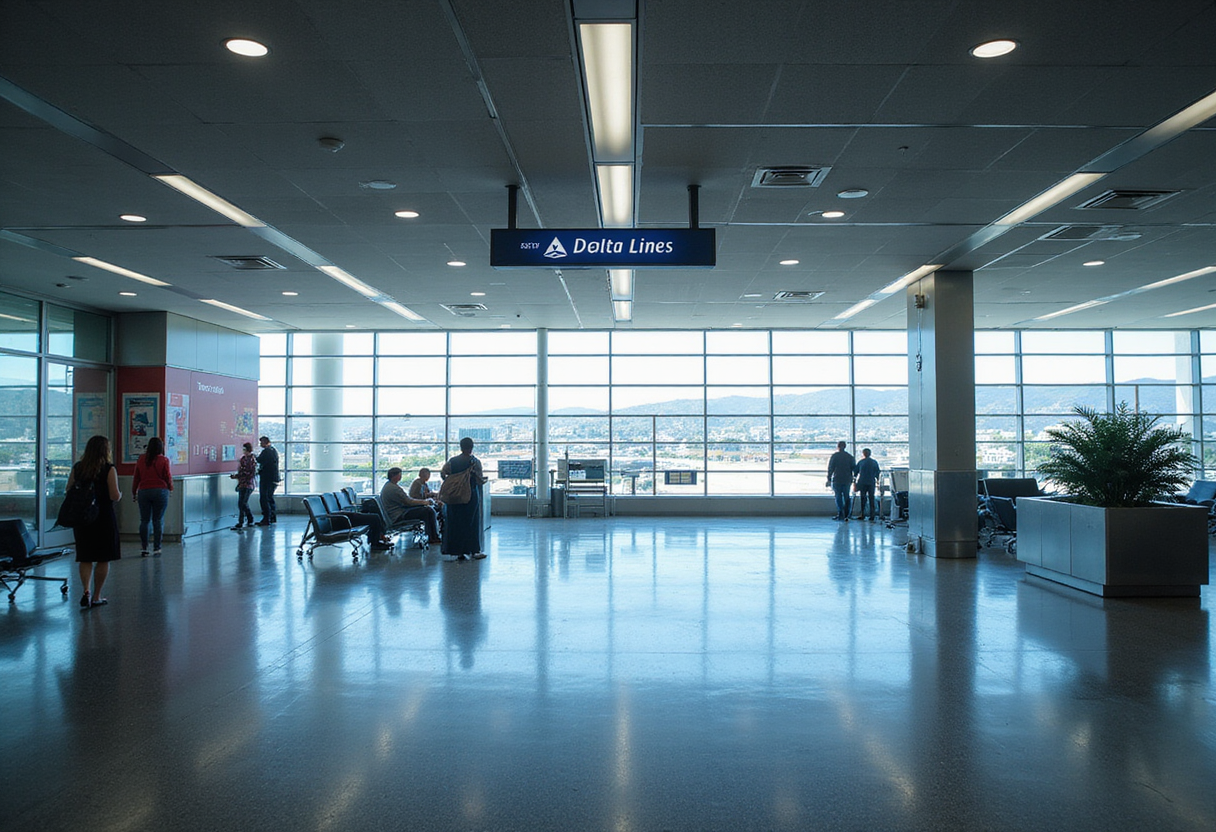
Delta Air Lines has publicly committed to becoming the No. 1 carrier at Los Angeles International Airport, a position it intends to capture through new routes and additional flights on existing service, the carrier confirmed in an announcement carried by PYOK.
The Atlanta-based operator is pursuing top billing at one of the United States' largest gateways by passenger volume, a field historically contested by American Airlines, United Airlines, and Southwest Airlines.
Delta currently ranks behind at least two of those carriers at LAX by capacity, making the climb to first place a multi-year build rather than a single-season push.
What does the announcement actually contain?
The PYOK report confirms only the strategic intent at headline level: new routes and added flights at LAX.
It does not enumerate specific origin-and-destination city pairs, start dates, aircraft types, or weekly frequency counts.
Without those details, the magnitude of the planned capacity expansion cannot be measured against Delta's existing LAX footprint from the source alone.
Whether the build-out represents a reallocation of flying from other Delta focus cities, the addition of new aircraft hours, or a combination of both is also not specified.
What would it take to be No. 1 at LAX?
American Airlines operates a substantial hub at LAX from Terminals 4 and 5, with a domestic schedule designed to feed long-haul international service to Asia, Australia, and Latin America.
United Airlines uses Terminals 7 and 8 as a West Coast gateway with significant transcontinental and Pacific frequencies.
Southwest Airlines operates a point-to-point network with multiple daily flights on competitive domestic city pairs.
Capturing the top ranking at LAX would require Delta to surpass the seat-capacity totals of whichever operator currently leads.
The metric used to claim No. 1 status varies — some carriers count seats, others count flights, others count destinations — but the competitive dynamic is the same: each percentage point of share at a top-five U.S. airport carries commercial weight.
Why Los Angeles is a strategic priority for Delta
Delta operates LAX as a focus city alongside its Atlanta, Detroit, Minneapolis-St. Paul, Salt Lake City, and Seattle hubs.
The West Coast position gives Delta routing options for transcontinental and Pacific service that complement its Atlanta transatlantic operation and Seattle Asia gateway.
A stronger LAX presence also improves connectivity for Delta's corporate accounts on the West Coast and opens new international city-pair options that currently route through competing hubs.
Being No. 1 at LAX would extend Delta's pricing leverage on transcontinental markets where it already competes with American and United.
Infrastructure and timing
A multi-year capital program at the airport includes new terminal construction ahead of the 2028 Los Angeles Olympic Games.
Carriers with established terminal positions and gate capacity at LAX will absorb incremental traffic more effectively during the Games period.
Delta has invested in Terminal 3, and a larger operational footprint would require additional gate access as the modernization program progresses.
What remains unclear
The specific routes, frequencies, equipment, and start dates that would convert this announcement into measurable capacity growth are not detailed in the source.
The size of the planned seat-capacity increase relative to Delta's current LAX operation is therefore unverified.
Delta has previously guided to a low-single-digit domestic capacity growth profile, a constraint that will frame how aggressively the airline can scale at LAX without trimming service elsewhere.
The carrier's path to the No. 1 ranking at LAX will become measurable once route filings, schedule updates, and operational data become publicly available.
via Google News: Airline routes (Source)
More from Sophie Lindqvist
Show full bio
Senior reporter covering industry trends and analytics at Flightdeck Report.
382 articles
Same bay
- FDR269Delta Adds Three Routes And Seven Frequency Boosts In LAX Network Reset · October 10, 2026
- FDR997Delta Adds European Routes From Detroit and Boston Hubs · September 29, 2026
- FDR743Delta Plans Largest-Ever LAX Schedule With 200-Plus Daily Departures · September 30, 2026
- FDR742Delta Moves to Add New European Routes · September 30, 2026
- FDR126Delta Adds New European Routes from Detroit and Boston · September 30, 2026