Clearance CLR-9706 · AIR451
AIRDRO
Airlines & NetworksClearance sheet
Drone-driven Russian airport closures push Belavia flights into the red
Belavia says Russian airport closures during drone attacks turn profitable flights into losses, with damages unquantified and all costs borne by the airline itself.
Read-back
- Belavia reports significant but unquantified losses from Russian airport closures caused by drone attacks
- Marketing head Katsiaryna Radzisheuskaya said closures typically turn a profitable flight into a loss-making one
- The airline is covering all associated costs itself; a damage assessment is still pending
- Transport ministry official Ihor Holub said the disruptions affect schedule reliability at Minsk National Airport and its international operators
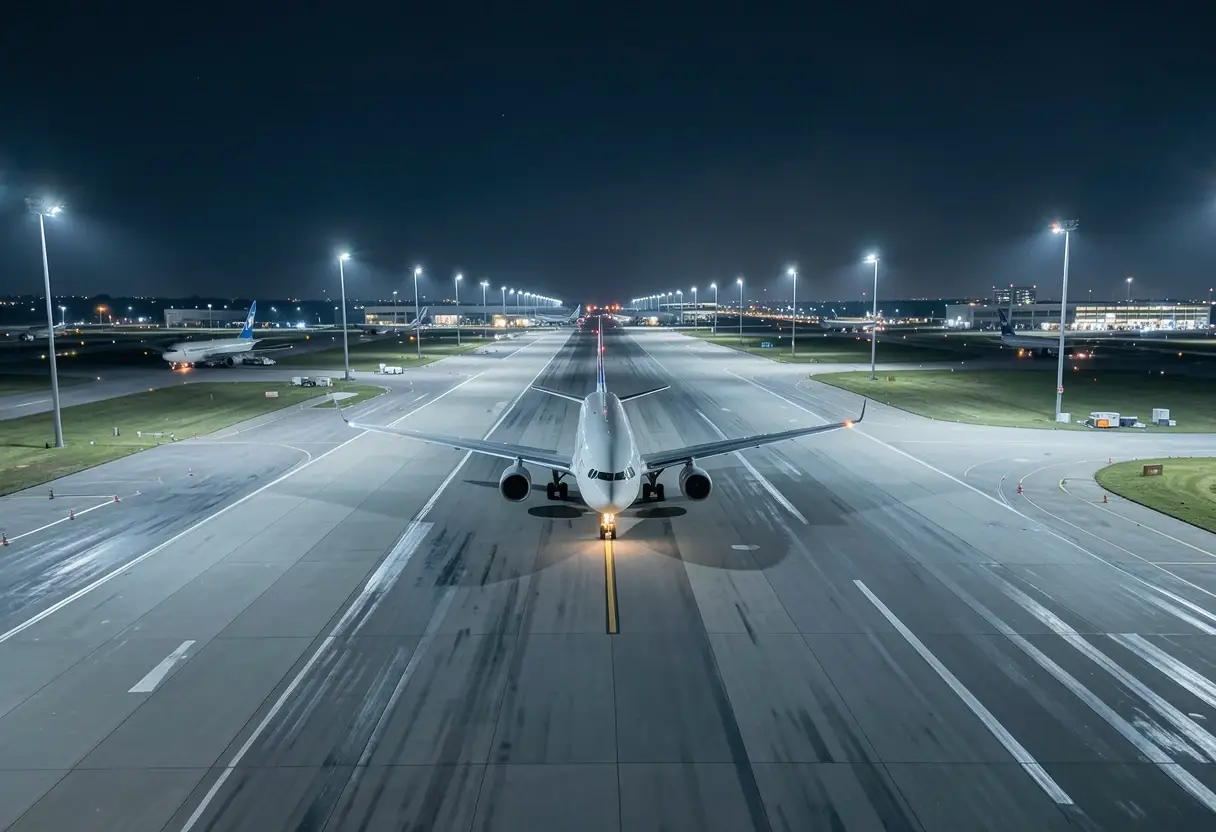
Belavia, the Belarusian national carrier, says periodic closures of Russian airports during Ukrainian drone attacks are inflicting significant financial losses, and it cannot yet put a number on the damage. Speaking at a press conference in Minsk marking Civil Aviation Workers' Day, Katsiaryna Radzisheuskaya, head of the airline's marketing and foreign economic activities department, said each flight is unique, which makes a total loss figure difficult to calculate. The financial repercussions, she emphasized, are significant.
The carrier is absorbing every rouble of those costs itself. A Belavia representative said the assessment of financial damages is still pending, with no external compensation in sight.
What actually happens to a flight when airports close?
Radzisheuskaya laid out the operational arithmetic with unusual candor. "A plane can circle in a holding pattern for an extended period, burning fuel, or remain on the ground at the airport while waiting to depart," she said. The alternatives are no cheaper: a captain may turn the aircraft around and return to the origin airport, or divert to an alternate airfield. "Each decision has consequences, including financial implications," she explained.
The verdict, in her words, is blunt. "Closure events, such as being in a waiting area, diverting to an alternate airport, or returning to the base airport, typically turn what could be a profitable flight into a loss-making one. These are our current realities."
For an airline of Belavia's scale — a state-owned carrier whose network runs heavily through Russian airspace — the exposure is structural rather than incidental. Every Moscow-bound or transit rotation that touches a closure window carries a chance of becoming fuel burned for no revenue earned.
How bad is the disruption for Belarusian aviation?
The ministry's own assessment matches the airline's. Ihor Holub, director of the aviation department at the Ministry of Transport and Communications, said Belarusian civil aviation faces flight delays, longer routes and longer flight times because of conditions in Russian airspace.
"This situation affects the reliability of the schedule adhered to by our air carrier, as well as by international companies operating at Minsk airport," Holub said. The impact, he noted, extends across both the airline and Minsk National Airport, meaning the damage is not confined to one operator's balance sheet but touches the hub's standing with foreign carriers as well.
Schedule reliability is the currency of any hub airport. When international operators cannot trust departure and arrival windows at Minsk, the cost lands on connection traffic and network planning, not just on individual flights.
Can the airline do anything about it?
Not much, by its own admission. Radzisheuskaya said the Belavia team has to "create miracles" to minimize delays, but conceded that not all factors sit within the company's control. Holding patterns, diversions and turnaround decisions are dictated by airspace conditions the airline neither causes nor manages.
The airline has promised no figures yet, and no timeline for producing them. Until a quantified assessment arrives, the losses remain a known cost without a known magnitude — a position few carriers would choose to publicize voluntarily.
With Russian airspace disruptions showing no sign of abating, Belavia faces the prospect of accumulating unbudgeted costs on a network that runs, by geography, directly through the affected area. A final damage tally, when it comes, will read as a ledger of holding patterns and diversions.
via Google News: Air traffic control and airspace (Source)
More from Grace Kim
Show full bio
News editor covering companies, deals and strategy in Commercial aviation industry coverage at Flightdeck Report.
555 articles
Same bay
- FDR751Russia grounds flights at 27 airports as drone attack tests airspace · October 16, 2026
- FDR191Moscow reports 75 drones downed overnight as airports shut · October 17, 2026
- FDR261Moldova Reports Airspace Incursion, Finds Drone Debris · September 27, 2026
- FDR403Ukraine Says It Has Started Closing Russian Airspace · October 9, 2026
- FDR525Moldova closes partial airspace after drone incursion · September 30, 2026