Clearance CLR-8384 · AIR559
AIRFRA
AirportsClearance sheet
Frankfurt Opens Terminal 3 Into a Shrinking Schedule
Fraport opened Frankfurt Terminal 3 on 22 April 2026, adding 19 million annual passenger places while flights fall 3.2% and the 2026 forecast drops to 63.2 million.
Read-back
- Fraport opened Frankfurt Terminal 3 on 22 April 2026, adding 19 million passengers of annual capacity.
- Frankfurt's summer 2026 flights fell 3.2%; winter 2026/27 seats fall 2.7% and departures 5%.
- Fraport cut its 2026 passenger forecast to 63.2 million from 65-66 million.
- OAG puts Frankfurt's November 2026 total seats at 2.96 million, down 6% year-on-year.
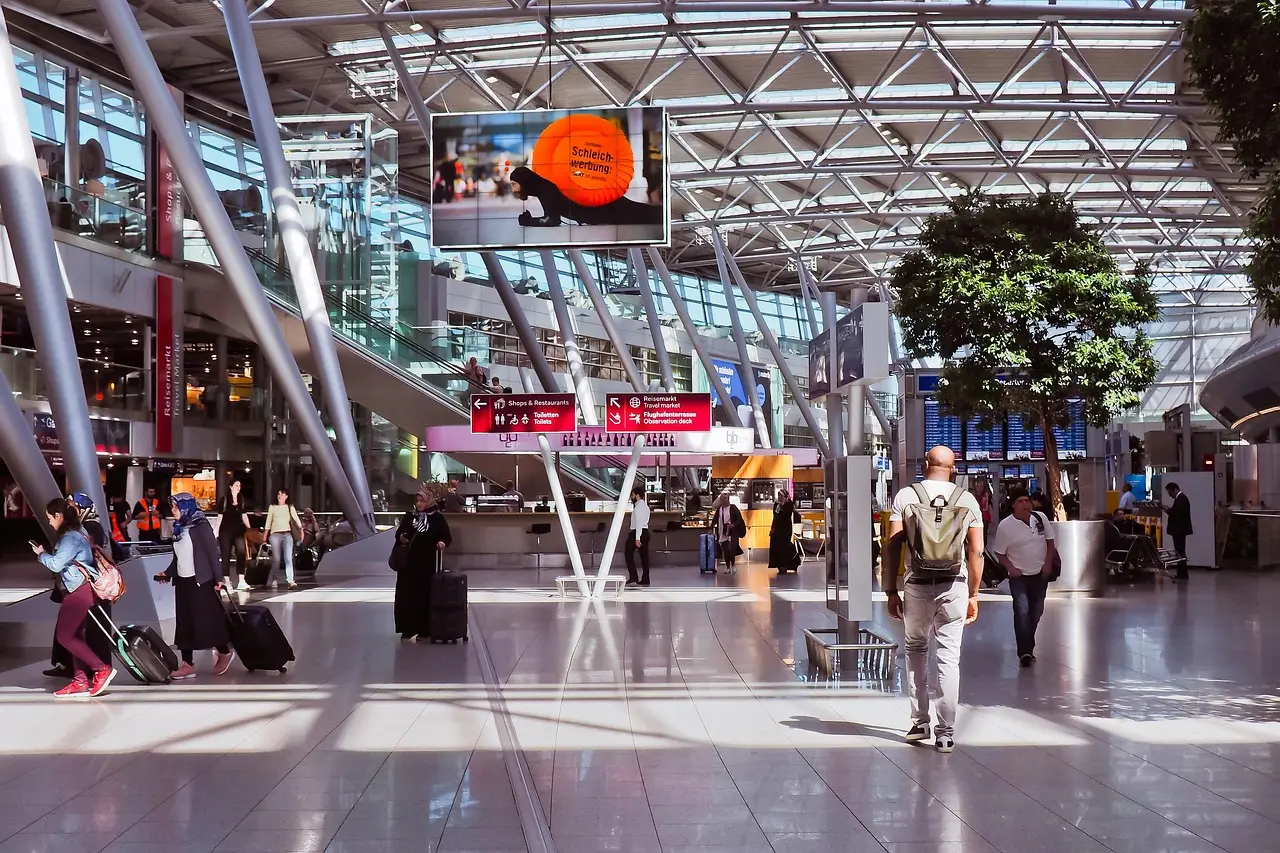
Fraport AG opened Terminal 3 at Frankfurt Airport on 22 April 2026, adding 19 million passengers of annual capacity to a hub whose scheduled flights are falling. The first commercial flight was scheduled for 23 April. More than 400 guests attended the ceremony, including Federal Transport Minister Patrick Schnieder, Hesse Minister-President Boris Rhein and Frankfurt Lord Mayor Mike Josef.
The timing is the story. Frankfurt's summer 2026 departure seat capacity stands at roughly 25.54 million, nearly flat year-on-year, while flight numbers fell 3.2%, according to Aviation Week & Space Technology. The winter 2026/27 schedule is weaker still: seats down 2.7% and departures down 5%. New concrete and fewer flights. The two trends do not often share a press release.
Fraport calls Terminal 3 the largest infrastructure project in its history, and Rhein went further at the opening, describing it as Europe's largest privately funded infrastructure project. Fraport says the build finished on schedule and on budget. For a project of this scale, that claim is worth noting precisely because it is rare; the airport operator has, at minimum, delivered what it promised in construction terms.
What do the traffic figures show?
The demand side matches the schedule data. Frankfurt handled about 28.9 million passengers in the first half of 2026, down 0.8% from the same period in 2025, according to a Fraport CEO statement reported by Yahoo Finance. June was worse: traffic fell 1.7% year-on-year to around 5.7 million.
Fraport has cut its full-year 2026 passenger forecast to 63.2 million, from a previous range of 65 to 66 million. That is a reduction of roughly two to three million passengers, or about 4%, in a single revision. The company attributes the weakness to Lufthansa strikes, the war in Iran and traveller uncertainty over jet fuel supplies.
OAG's November 2026 data extends the pattern. Frankfurt ranked sixth in Europe for total seats with 2.96 million, down 6% year-on-year. Globally, it placed tenth for international seats at 2.65 million, down 5%. Those are sharp declines for an airport that has just commissioned its largest terminal.
Germany as a whole is soft. Summer 2026 departure seats across German airports were approximately 87.8 million, down 0.7% year-on-year, with departures falling 3.4% to about 478,300, according to Aviation Week & Space Technology. Frankfurt's problem is partly a national one, and the terminal cannot solve it alone.
Why build capacity into decline?
The mismatch deserves a careful reading rather than a cynical one. Terminal capacity is a necessary condition for growth, not a sufficient one. The 19 million new places remove a physical ceiling at the moment airlines are pulling seats for reasons unrelated to airport infrastructure. The building was planned years ago; the schedule cuts are happening now.
Fraport COO Dietmar Focke framed the constraint explicitly, telling Aviation Week & Space Technology: "A competitive German aviation market requires transparency and efficiency from infrastructure providers and a policy framework that enables airlines to deploy capacity with long-term confidence." The wording points at policy, not concrete, as the binding limit on Frankfurt's growth.
The terminal's stated purpose also matters. Terminal 3 was designed around Frankfurt's position as a long-haul connecting hub rather than incremental domestic traffic. Its value depends on carriers, chiefly Lufthansa, choosing to concentrate connecting traffic there. Current schedule data show the opposite direction of travel, at least for now.
What happens next?
Terminal 3 is a long-term asset opened at a short-term low. Completed on time and on budget, it gives Frankfurt room the airport did not previously have. The evidence to date — falling flights, a cut forecast of 63.2 million passengers and November seat declines — shows the opening has not reversed the traffic trend by itself.
The next two or three scheduling seasons will show whether the mismatch persists or whether airlines fill the new space once the external shocks named by Fraport, and the policy environment described by Focke, allow capacity to return.
via theaviationhub.co.uk (Source)
More from Grace Kim
Show full bio
News editor covering companies, deals and strategy in Commercial aviation industry coverage at Flightdeck Report.
584 articles
Same bay
- FDR211Fraport's €4 Billion Terminal 3 Handles 4.4 Million Passengers · November 11, 2026
- FDR900Berlin Brandenburg Nears 30 Million Passengers Betting on Point-to-Point · October 2, 2026
- FDR884Fraport Signs Kühne+Nagel Lease for New Air Cargo Warehouse · October 14, 2026
- FDR202Fraport passes pre-pandemic traffic as Frankfurt flatlines · November 8, 2026
- FDR258Fraport's Frankfurt cargo plan puts cooperation before expansion · November 4, 2026