Clearance CLR-4947 · AIR768
AIRHUN
Airspace & RegulationClearance sheet
Hundreds of US flights disrupted as ATC breakdown spotlights aging system
An air-traffic-control outage displaced hundreds of US flights this week, casting renewed attention on the aging National Airspace System hardware that watchdogs have flagged for years.
Read-back
- Hundreds of US flights were disrupted by an ATC outage on Monday.
- The incident was classified as an "air traffic control calamity" spotlighting the aging federal system.
- US en-route centers rely on hardware originally commissioned in the 1980s and 1990s.
- FAA NextGen modernization was formally adopted in 2007 and remains incomplete.
- A mid-week ATC failure typically drives 5–15% schedule erosion across affected regions for the following 24–48 hours.
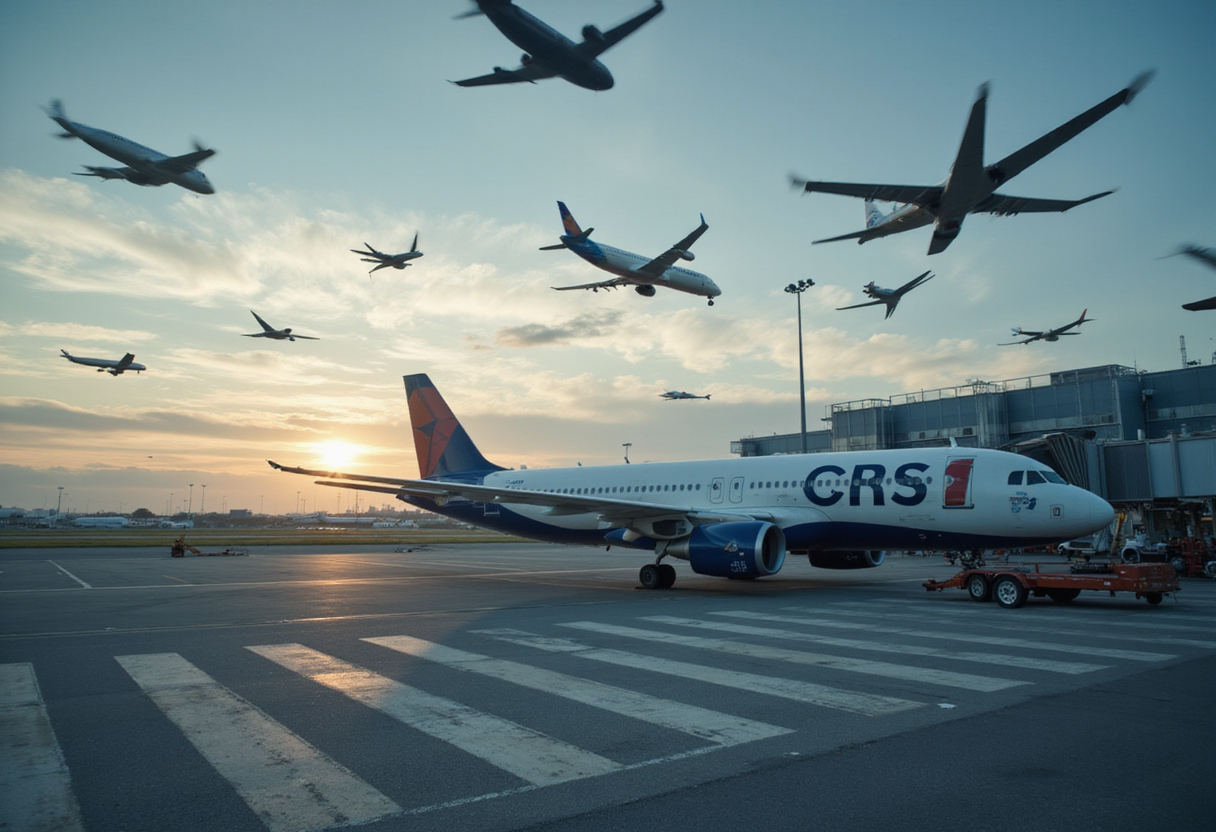
An air-traffic-control outage displaced hundreds of US flights this week, in an incident framed in Monday reporting as "an air traffic control calamity" that "spotlights the aging system" responsible for managing the world's busiest commercial aviation network.
How big was the disruption?
The headline figure — "hundreds" — sits well below the scale of the January 2023 NOTAM failure that grounded the entire US fleet for several hours, but above ordinary weather-driven ground-stop totals. Three-digit cancellation and delay counts typically register across each of the four US hub-heavy network carriers — American Airlines, Delta Air Lines, United Airlines and Southwest Airlines — when an outage strikes close to a major field, given the cascade effect through crew-connection banks and downstream turn times.
What does "aging system" actually mean?
US air-traffic infrastructure includes hardware commissioned during the 1980s and 1990s at the 21 en-route centers that route aircraft above roughly 24,000 feet, alongside shorter-range terminal radar approach controls at major hubs. The FAA's NextGen modernization programme, launched in the mid-2000s and formally adopted as a portfolio in 2007, set out to replace voice-based ground infrastructure with satellite-enabled surveillance and digital datalink communications. Progress has been uneven; legacy components tied to the flight-information processing backbone have remained in service during transition periods, creating the conditions under which a Monday-classified outage can recur.
What's the carrier-side cost?
A mid-week ATC failure typically translates into 5–15% schedule erosion across affected regions for the following 24–48 hours, depending on recovery time for crews and aircraft into legal sequence for the next day's operation. Legacy hub-and-spoke operators absorb the irregular-operations expense directly: hotel and meal rebookings, DOT-mandated compensation, and burned crew duty limits that flow into pay-protect claims on subsequent pairings.
What's the regulator response?
The FAA has historically answered similar incidents with a combination of accelerated modernization procurement and targeted component replacement, particularly after high-visibility outages. Inspector-general audits have repeatedly flagged sustainment backlogs in en-route and tower automation systems. Air-traffic controllers' union officials have publicly tied the same exposure window to understaffing at individual facilities, a question that Monday's flagged incident does not itself resolve.
What's the network consequence?
For carriers running tight connections through Chicago O'Hare, Atlanta, Denver, Charlotte and Newark, even a 45-minute system blip at one site cascades into the next departure bank, often with Saturday-style recovery on a weekday. The exposure is most pronounced during summer thunderstorm season, when ATC automation is already compensating for weather diversions.
What's next?
Federal aviation appropriations for fiscal 2026 — and any supplemental request from the FAA for NAS replacement hardware — will be the next inflection point to watch, alongside any DOT inspector-general follow-on referral. Each successive outage narrows the political window for the kind of multi-year capital program that hasn't been fully funded since the early 2000s.
via Google News: Air traffic control and airspace (Source)
More from James Calloway
Show full bio
Staff writer covering industry trends and analytics at Flightdeck Report.
383 articles
Same bay
- FDR400Hundreds of US flights disrupted as aging ATC system falters · October 10, 2026
- FDR513ATC Failure Grounds Hundreds of US Flights, Exposing Ageing Infrastructure · September 28, 2026
- FDR365ATC Failure Disrupts Hundreds of US Flights, Exposing Aging System · September 28, 2026
- FDR753Air Traffic Control Failure Disrupts Hundreds of US Flights · October 10, 2026
- FDR191US Insists New Air Traffic Control System Will Avoid Disruptions · September 30, 2026