Clearance CLR-7068 · AIR711
AIRPOK
AirportsClearance sheet
Pokhara International Airport Bans Kites, Drones, Balloons and Lasers Near Airspace
Pokhara International Airport has banned kites, drones, balloons and laser lights near its airspace, targeting hazards that force go-arounds and burn schedule margin.
Read-back
- Pokhara International Airport prohibits kites, drones, balloons and laser lights near its airspace
- The ban targets objects that force go-arounds and disrupt approaches at the terrain-enclosed Nepali airport
- Laser strikes aimed at cockpits on final approach are among the hazards covered by the restriction
- Enforcement will determine whether other Nepali airports adopt similar bans
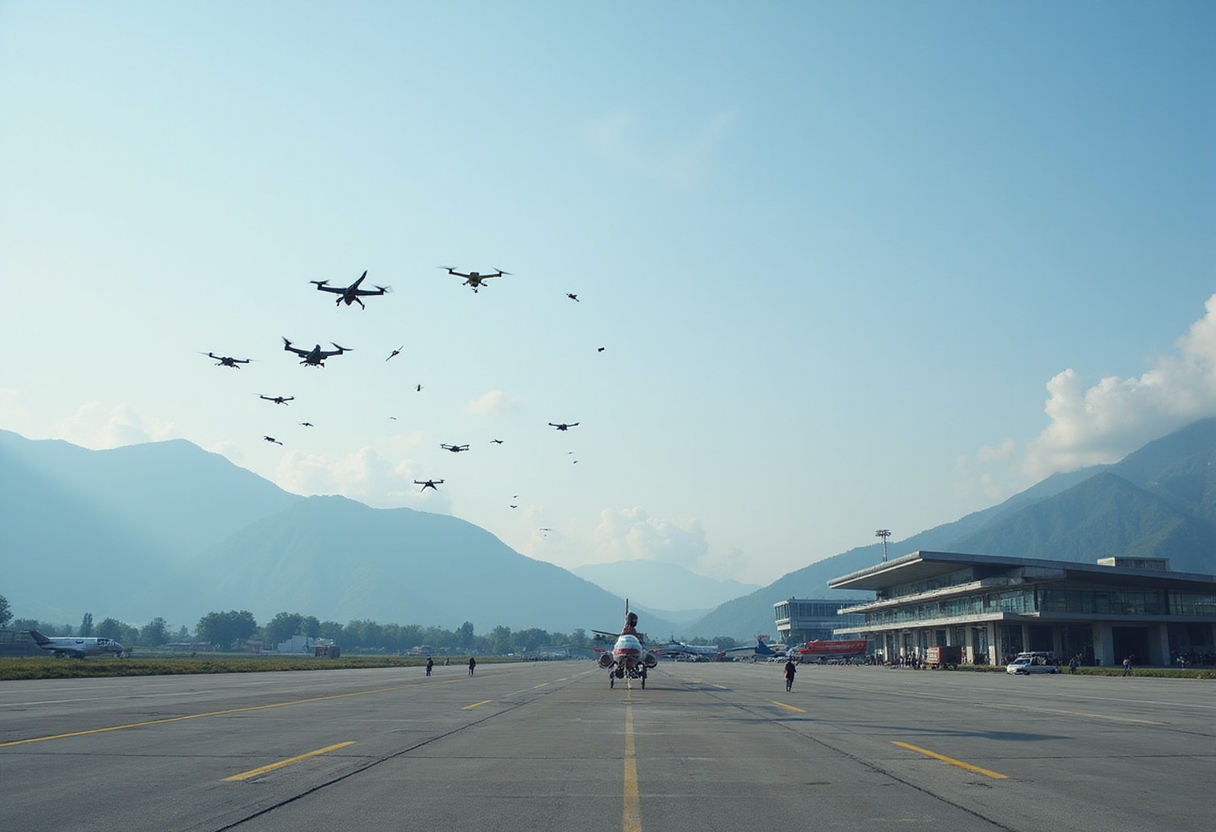
Pokhara International Airport has banned kites, drones, balloons and laser lights near its airspace, prohibiting the objects most frequently blamed for disrupting approaches and departures at the Nepali gateway.
The restriction, reported by Ratopati, covers the four categories of unofficial aerial activity outright. Airport authorities acted after recurring incidents in which kites and balloons drifted into approach paths and laser beams were aimed at cockpits on final approach — hazards that force go-arounds, delay departures and consume capacity at an airport that depends heavily on smooth turnaround times.
Pokhara sits in a valley ringed by terrain, which compresses the maneuvering space available to crews when an approach is compromised. A kite string or an unmanned drone in the final approach corridor leaves a flight crew little option but to abandon the approach; a laser strike on final can temporarily blind a pilot at the most critical phase of flight. For an airport of Pokhara's scale, a single go-around ripples through the day's schedule in a way it would not at a large hub with parallel runways and slack capacity.
Why do these particular objects draw a ban?
Each item on the prohibited list attacks a different phase of flight:
- Kites and balloons — uncontrolled objects that can enter the approach path or climb into the departure corridor, with kite string posing a particular risk to engines and windshields.
- Drones — unmanned aircraft whose operators often lack authorization; a drone sighting on or near the runway triggers mandatory suspension of movements under standard international practice.
- Laser lights — deliberately or carelessly aimed beams that can flash-blind pilots during the visual approaches common at Pokhara.
Laser strikes in particular have grown into a global nuisance, and regulators across multiple jurisdictions have criminalized aiming lasers at aircraft. Nepal's civil aviation authority treats interference with flight operations as a prosecutable offense, and airport-level bans such as Pokhara's typically carry enforcement provisions backed by that national framework.
What does it mean for operations and passengers?
For airlines serving Pokhara, the ban is a capacity-protection measure. Every avoided go-around preserves fuel, maintains the aircraft's slot and keeps the daily rotation intact — margins that matter more at a regional destination than at a hub. For the airport operator, tighter control of the airspace immediately surrounding the field reduces the frequency of runway closures triggered by object sightings, the most disruptive single event a small airport can experience short of an accident.
The restriction also signals to carriers and their insurers that Pokhara's management is actively working down the risk profile of ground-adjacent operations, a relevant consideration in a country where aviation safety oversight draws close international scrutiny.
Can the ban be enforced?
Enforcement is the open question. Kites in South Asia are typically flown from rooftops and open ground across wide areas, not from a single controllable site, and consumer drones are inexpensive and widely available. Airport police and local authorities will need to patrol the approach corridors and prosecute violations visibly for the prohibition to change behavior, rather than existing on paper.
The effectiveness of the measure will become clear in the operating statistics: if laser strikes and object-related go-arounds at Pokhara decline in the coming seasons, other Nepali airports facing the same hazards — and there are several — are likely to follow with identical bans.
via Google News: Air traffic control and airspace (Source)
More from James Calloway
Show full bio
Staff writer covering industry trends and analytics at Flightdeck Report.
388 articles
Same bay
- FDR924EASA widens Saudi airspace warning after Houthi airport strike · October 9, 2026
- FDR820EU Aviation Agency Issues Saudi Airspace Advisory After Houthi Attacks · September 30, 2026
- FDR310Houthis Hit Riyadh Airport Again and Threaten Wider Saudi Airspace Attacks · October 8, 2026
- FDR271EASA Orders Avoidance of Parts of Saudi Airspace Until Nov. 16 · September 30, 2026
- FDR525Moldova closes partial airspace after drone incursion · September 30, 2026