Clearance CLR-3581 · AIR142
AIRTHA
Air CargoClearance sheet
Thailand Floods Halt Four Toyota Plants and Air Cargo Acceptance
Four Toyota plants in central Thailand have halted operations amid severe flooding, with air cargo acceptance suspended alongside the production stoppages, according to TimesLIVE.
Read-back
- Four Toyota plants halted operations in central Thailand amid severe flooding
- Air cargo acceptance suspended at Thai gateways in parallel with the production stoppages
- Specific facilities affected and expected timeline not disclosed in the TimesLIVE dispatch
- Bangkok region identified as the geographic centre of the disruption
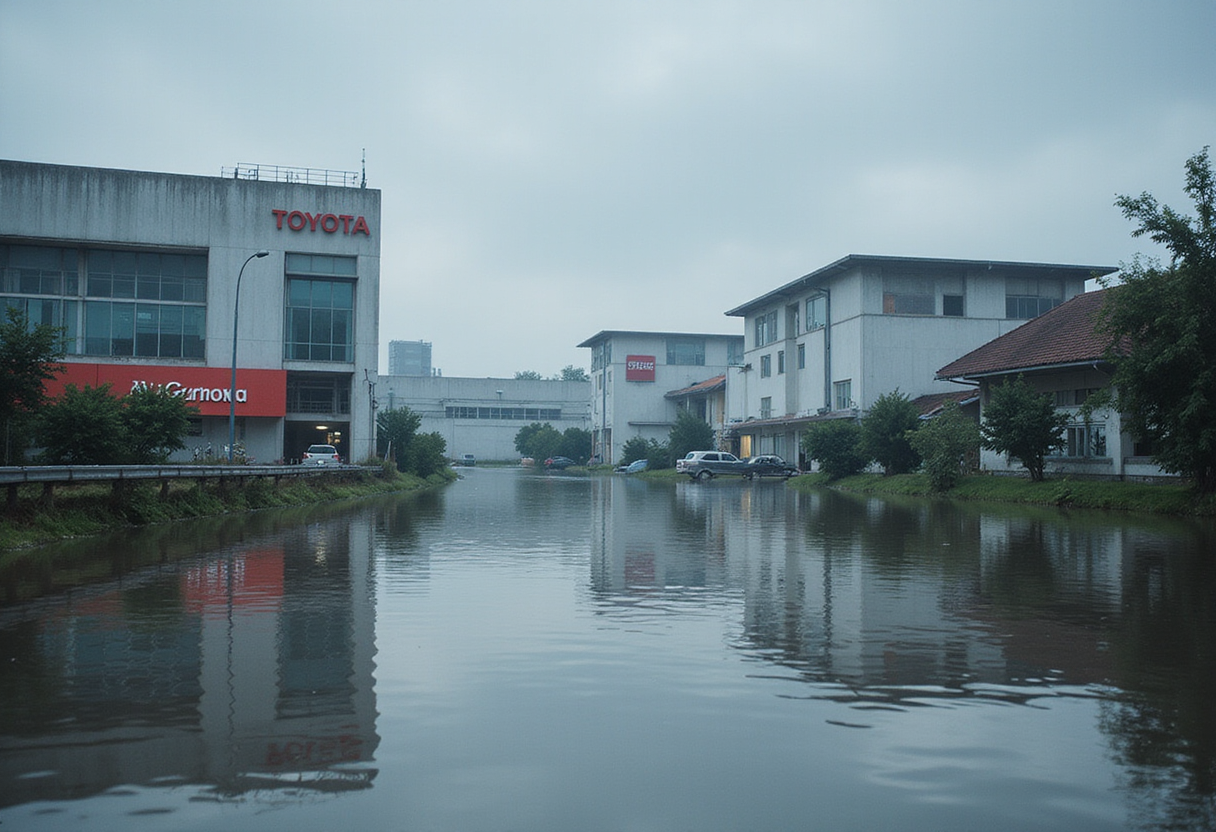
Four Toyota assembly and component plants in central Thailand suspended operations as severe flooding swept the Bangkok region, with local air cargo acceptance halted alongside the automaker's production stoppages, TimesLIVE reported.
The dispatch, carried by the South African outlet, confirmed the four-plant stoppage but did not disclose which facilities are affected, the expected duration, or the precise cargo terminals that have closed acceptance windows. The headline fact — four Toyota plants and parallel air-freight disruption — remains the only operational data on the public record.
What is the scale of the production halt?
Four plants represent a meaningful share of Toyota's Thai footprint. The automaker operates multiple body, paint, engine and transmission sites east of Bangkok, alongside stamping and parts facilities. Toyota Motor Thailand has not, in the TimesLIVE dispatch, named the lines affected, leaving open whether the stoppage hits body-and-paint operations, which are more exposed to water damage, or powertrain sites that can sometimes resume faster.
Thailand has historically accounted for a leading share of Southeast Asian vehicle output, with Toyota's Thai operations serving as an export node for pickup trucks, passenger cars and diesel engines shipped across ASEAN and to markets further afield.
Why does air cargo stop with the plants?
Automotive supply chains are tightly sequenced. When assembly lines idle, outbound shipments of engines, electronics and small high-value parts effectively cease at source. Return logistics on tooling and prototypes do not offset the loss. Acceptance halts at the cargo terminal typically follow the production stoppage within hours, signalling that forwarders are responding to confirmed upstream disruption rather than to speculative risk.
Bangkok's Suvarnabhumi (BKK) and Don Mueang (DMK) gateways handle the bulk of Thai air-freight throughput, including integrator networks operated by FedEx, UPS and DHL and the belly capacity of Thai Airways International and other scheduled carriers. The TimesLIVE reference to air-cargo acceptance being halted indicates that at least one freight handler at a Thai gateway has stopped accepting automotive shipments.
Which routes are most exposed?
Both BKK and DMK sit within the broader Chao Phraya floodplain, the catchment historically most exposed to monsoon inundation. Past floods have driven forwarders to reroute Thai-origin automotive shipments to:
- U-Tapao (UTP) in Rayong, outside the worst-hit catchment
- Malaysia's Subang (SZB) for integrator overflow
- Singapore Changi (SIN) as a regional backup
Carriers rarely publish specific flood-related diversions in real time, leaving forwarders and shippers to manage capacity shifts through their own networks.
How long could the disruption last?
The dispatch gives no timeline, and Toyota's Thai operations have not commented beyond the TimesLIVE headline. Recovery from previous Thai flood events has ranged from days, when component supply and press-shop lines escaped water damage, to several weeks when body and paint operations required electrical and structural inspection. Until flood waters recede and the four facilities pass safety checks, the air-cargo envelope around Bangkok is unlikely to reopen at full capacity.
What happens next?
Two checkpoints will set the next milestones: a Toyota Motor Thailand statement identifying the affected lines, and a Thai government flood-relief bulletin from the Royal Irrigation Department or the Department of Disaster Prevention and Mitigation. For air-cargo operators, the first sign of normalisation will be the resumption of acceptance windows at the BKK and DMK freight terminals. Until then, expect forwarders to weigh the cost of routing through U-Tapao, Subang or Changi against the prospect of a short Bangkok stoppage.
via Google News: Air cargo (Source)
More from James Calloway
Show full bio
Staff writer covering industry trends and analytics at Flightdeck Report.
385 articles
Same bay
- FDR111Thai floods force Toyota plant shutdowns, disrupt air cargo · October 10, 2026
- FDR178Suphajee challenges Thai Airways over seven-day cargo halt · October 10, 2026
- FDR889Thai PM and Airbus executives discuss SAF and investment · October 2, 2026
- FDR989Southeast Asia's Airlines Step Up Fleet Expansion · October 10, 2026
- FDR256Thai Airways Cargo Disruption Threatens Export Flows · October 1, 2026