Clearance CLR-7527 · SAF388
SAFBEA
Safety & OperationsClearance sheet
BEA reenacts Nice approach to test A320 runway-lighting near miss
BEA ran a January 2026 night-flight reenactment at Nice to test how runway lighting contributed to a September 2025 serious incident in which a Nouvelair A320 overflew an easyJet A320 by about three metres.
Read-back
- Serious incident occurred on 21 September 2025 at approximately 21:30 local time at Nice Côte d'Azur Airport (NCE).
- Nouvelair A320-200 cleared for runway 04L but lined up with 04R; radio altitude dropped from 39 ft to 10 ft in one second before climbing to 24 ft.
- Nouvelair passed within approximately three metres of the easyJet A320-200 that was stationary on the centreline.
- BEA conducted the night-flight reenactment in January 2026 using an easyJet crew and aircraft, the SAG helicopter unit and STAC lighting analysis.
- Four improvement areas identified: crew knowledge of aerodrome features, lighting regulations and checks, A-SMGCS use, and DSNA safety-occurrence handling.
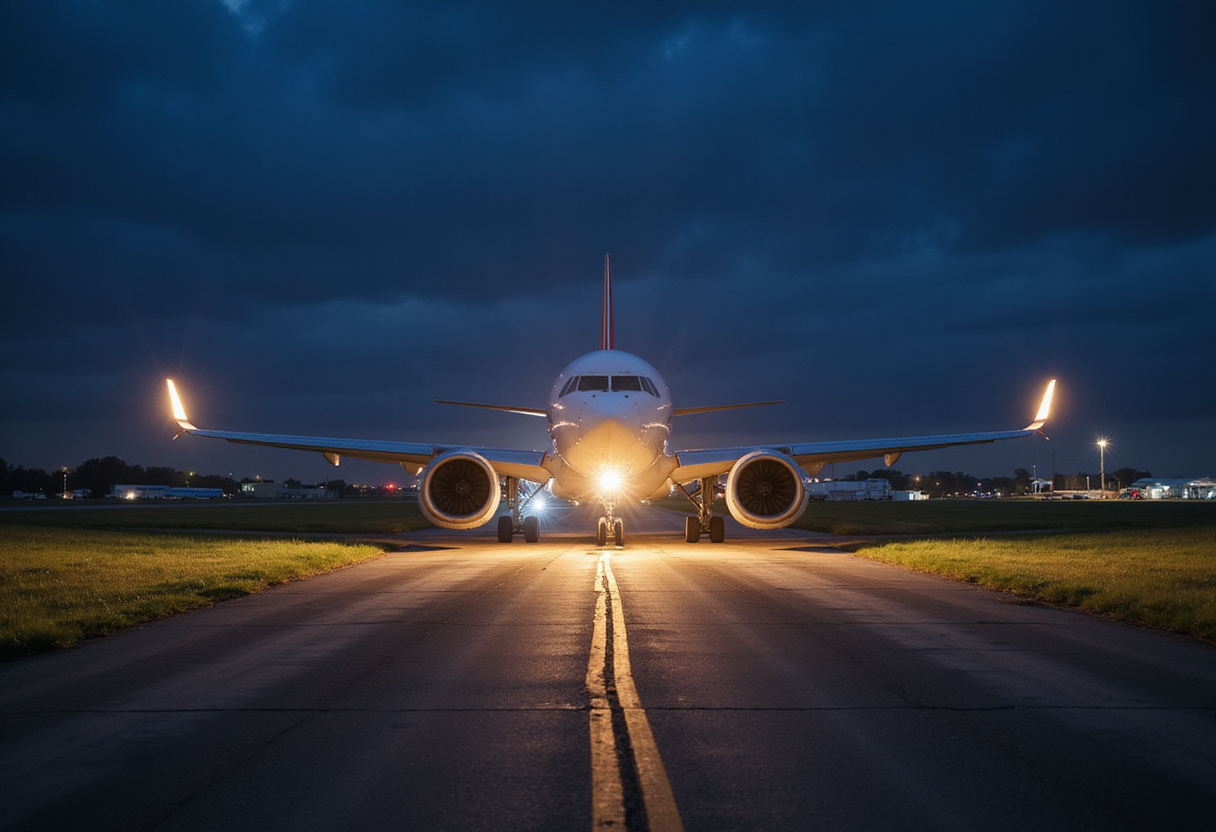
On 21 September 2025 at Nice Côte d'Azur Airport (NCE), a Nouvelair Airbus A320-200 overflew a stationary easyJet A320-200 by roughly three metres, prompting France's BEA to run a January 2026 night-flight reenactment to test how runway-lighting geometry may have contributed to the serious incident.
The reenactment used an easyJet crew and aircraft, supported by French air-navigation services, the airport operator, the Hyères Gendarmerie Air Section (SAG) helicopter unit, and the Service Technique de l'aviation Civile (STAC), which separately analysed the photometric characteristics of the runway lighting.
What happened on the night?
At about 21:30 local time on 21 September 2025, a Nouvelair A320 crew received and readback clearance to land on runway 04L at Nice. The aircraft instead lined up with runway 04R, where an easyJet A320 was stationary on the centreline awaiting departure clearance.
Flight-data recovered by the BEA showed the Nouvelair's radio altitude dropping from 39 ft to 10 ft in one second before climbing to 24 ft the following second as the crew rejected the landing. The Nouvelair passed within approximately three metres of the easyJet aircraft, according to the October 2025 preliminary report.
The BEA published its latest update on 21 September 2026, exactly one year after the event.
Why a reenactment?
The September 2026 update, which builds on the October 2025 preliminary report, focused on weather conditions at the time of the event, flight-recorder data, ATC systems, radiocommunications, and crew and controller interviews. Investigators also reviewed controller and pilot training, applicable European aerodrome-lighting regulations, and previous occurrences of runway confusion at Nice.
A large share of the inquiry turned on the approach itself — specifically, how the lighting of runways 04L and 04R was perceived from the air on the night.
To isolate that variable, BEA coordinated a night flight with French air-navigation services, the Nice airport operator and easyJet, which supplied the cockpit crew and airframe. The Hyères SAG provided helicopter support. STAC ran parallel analysis on the optical properties of the runway lighting and how pilots perceive them.
What has the investigation identified so far?
The BEA said the work has so far produced a refined sequence of events and "several areas of analysis." Four themes for improvement emerged from the data:
- Crew knowledge of specific aerodrome features
- European regulatory requirements for aerodrome lighting, particularly the methods used to check it on the ground and in flight
- Use of the Advanced Surface Movement Guidance and Control System (A-SMGCS)
- Direction des Services de la Navigation Aérienne (DSNA) handling of safety occurrences
"At this stage of the investigation, the information collected has made it possible to specify the sequence of the serious incident and to develop several areas of analysis," the BEA said.
The agency added: "These points may evolve according to the results of the work still in progress."
What could change?
The investigation is continuing, and any final outputs — safety recommendations or messages designed to prevent recurrence — will follow once contributing factors are fully identified. BEA investigators are also weighing whether European procedures for runway-lighting checks, both on the ground and in flight, need to be tightened.
Both carriers operate A320-family fleets with significant exposure to night operations at busy dual-runway fields across Europe. easyJet supplied the cockpit crew and aircraft used in the January 2026 reenactment, while Nouvelair runs scheduled and charter services from Tunis.
A final BEA report, expected to consolidate lighting, crew-familiarity and ATC findings, will determine whether French aviation regulators and the wider European airport community revisit approach-lighting standards at dual-runway fields similar to Nice.
via stac.aviation-civile.gouv.fr (Original)
More from Sophie Lindqvist
Show full bio
Senior reporter covering industry trends and analytics at Flightdeck Report.
329 articles
Same bay
- FDR890TAIC finds systemic failures behind Air NZ Q300 low-altitude incident · September 30, 2026
- FDR241Poland Scrambles Fighters, Halts Border Airports as Russian Jet Drone Nears · September 30, 2026
- FDR283Flydubai 737 MAX 8 Diverts to Tabuk After 7500 Squawk · September 30, 2026
- FDR103Libya Orders Detention of Pilots in Misrata Citation Crash · September 30, 2026
- FDR756Ethiopian suspends Tigray flights after TPLF seizes Mekelle airport · October 9, 2026