Clearance CLR-4956 · AIR745
AIRBOE
Aircraft & EnginesClearance sheet
Boeing Secures Major China Aircraft Order After Trump-Xi Summit
Boeing has secured a major commercial aircraft order from China following the Trump-Xi summit, per airlinergs.com reporting. Aircraft counts, model mix, and carrier allocations remain undisclosed.
Read-back
- Boeing confirmed a major Chinese aircraft commitment following the Trump-Xi summit, per airlinergs.com reporting.
- Initial coverage did not specify aircraft count, model mix, delivery profile, or participating carriers.
- Chinese carriers had effectively suspended Boeing acceptances for the better part of the prior year amid the US-China trade dispute.
- Airlines likely to disclose their role include Air China, China Eastern, and China Southern, once contract talks advance.
- The deal's conversion into firm orders will shape Boeing's working-capital position and 2026 delivery cadence.
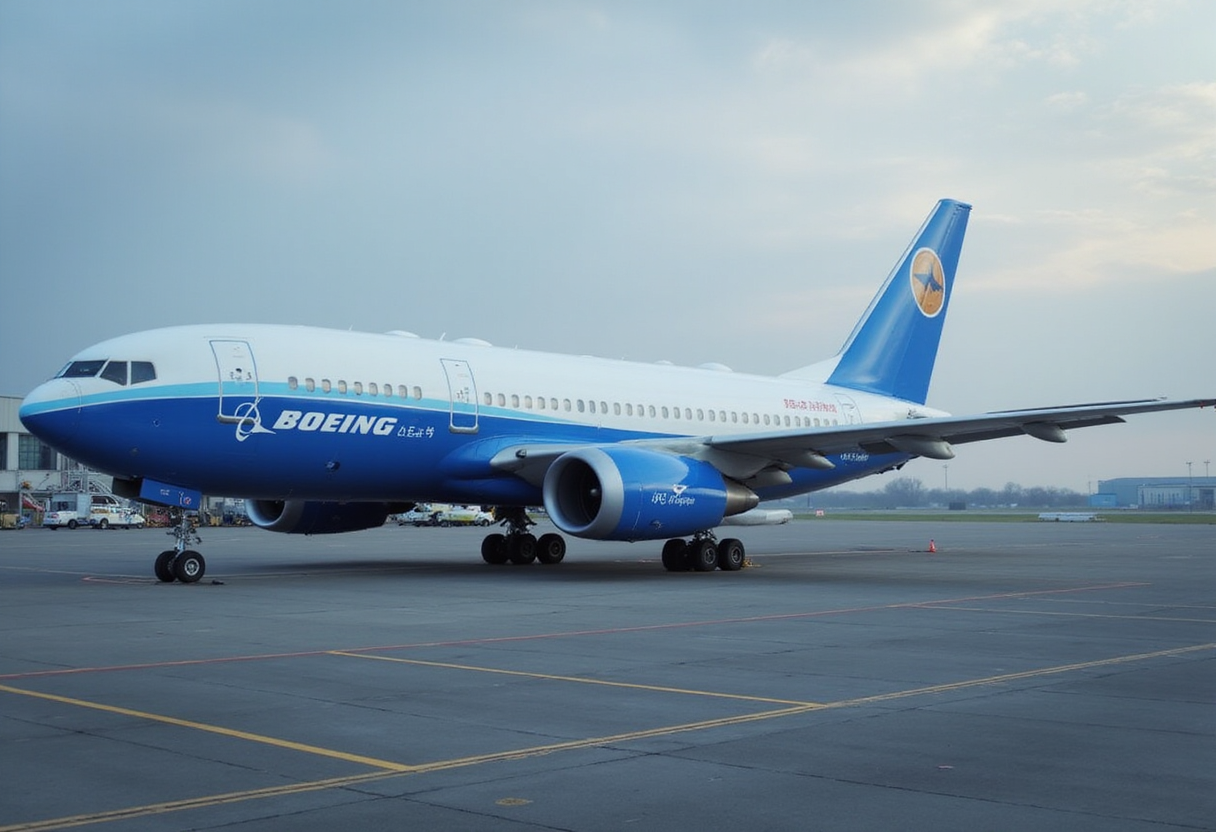
Boeing has secured a major commercial aircraft commitment from China following direct engagement between US President Donald Trump and Chinese President Xi Jinping, according to initial reporting carried by airlinergs.com. The agreement, framed explicitly as a post-summit outcome, lifts a geopolitical freeze that had effectively halted Chinese carriers' acceptance of new Boeing jets for the better part of a year.
The deal's confirmed details, as published, are limited to its existence, its trigger event, and its scale descriptor — a "major" order. The reporting does not specify aircraft count, model mix, delivery profile, or the participating carriers.
What details remain undisclosed?
Three categories of information will determine the deal's real weight on Boeing's 2026 delivery book:
- Airline allocation among major Chinese carriers and Chinese-linked lessors
- Mix between 737 MAX narrowbodies and twin-aisle 787 or 777 aircraft
- Delivery cadence across 2026, 2027, and 2028
Without those specifics, the commitment's effect on Boeing's revenue trajectory remains a forecast rather than a settled number.
Why does the political timing matter?
Chinese carriers had effectively suspended new Boeing acceptances for most of the past year as part of a parallel political and commercial dispute. Aircraft produced for Chinese customers reportedly sat parked outside the continental US, awaiting both contract terms and a diplomatic opening.
The summit's signaling appears to have broken that stalemate. Boeing and the carriers' procurement teams can now move from stalled negotiations back toward signing.
What it means for Boeing's books
Each restored Chinese delivery clears pre-delivery payments already received from inventory into recognized revenue. The conversion also underwrites production-rate assumptions at the 737 and 787 lines, where Boeing has been working to normalize output after years of disruption.
For a manufacturer juggling working-capital targets across multiple aircraft programs, the China pipeline acts as both a demand backstop and a cash-flow catalyst.
What does it mean for capacity?
Chinese carriers have spent the past several years rebuilding international long-haul capacity toward pre-disruption levels on key route pairs. Boeing's widebody products compete directly with the Airbus A330neo and A350 family. The split between narrowbody and widebody in any new deal will indicate how aggressively Chinese carriers intend to push international expansion versus the domestic and regional networks where 737 MAX aircraft compete head-to-head with the Airbus A320neo family.
How does this compare with prior deals?
Past US-China commercial summits produced framework agreements that, in some cases, took years to convert into firm orders with named aircraft and allocated delivery positions. The size of the announced commitment will only be judged against those reference points once specific airframes and customers are disclosed.
Pricing visibility, export-credit treatment, and any financing terms attached will shape whether the deal resembles earlier framework announcements or falls materially below them.
What to watch next
Boeing's commercial teams and their Chinese counterparts must translate the political signal into signed purchase contracts and slot allocations. Investors, suppliers, and competing OEMs will read those subsequent announcements for evidence that the summit's atmospheric improvement has produced firm, dated delivery positions rather than a headline-grade commitment that fades during contracting.
For now, the deal's most durable fact is geopolitical: a return of Chinese government engagement with Boeing's commercial pipeline after an extended pause. The commercial translation arrives only when aircraft counts, customer names, and delivery dates reach a contract.
via Google News: Aircraft orders and fleets (Source)
More from Nathan Brooks
Show full bio
Correspondent covering media and advertising at Flightdeck Report.
348 articles
Same bay
- FDR354Beijing Confirms Boeing Aircraft Order Following Trump's Visit · October 10, 2026
- FDR170Boeing Shares Fall as Trump Unveils Smaller China Aircraft Order · September 28, 2026
- FDR982Boeing Shares Rise on Expected China Aircraft Order · September 27, 2026
- FDR955China Ties 200 Boeing Jets to US Trade Deal With Tariff Cuts · October 10, 2026
- FDR233Beijing Confirms Boeing Order Following Trump's China Visit · October 10, 2026