Clearance CLR-9271 · AIR796
AIRCLO
Airspace & RegulationClearance sheet
Closed Eurasian Airspace Is Compressing U.S. Strategic Airlift Options
Chinese carriers now fly 83% of China–Europe capacity while USTRANSCOM's paper fleet of 275 airlifters hides a harder problem: cumulative loss of political access across Eurasia.
Read-back
- Chinese airlines' share of China–Europe scheduled capacity rose from 55% in summer 2019 to 83% by summer 2025, with total market capacity flat.
- Azerbaijan's daily overflights more than doubled from 278 in early 2022 to 695 by end-2025; annual overflights grew from 47,065 (2021) to 261,085 (2025).
- Dubai's first-half 2026 traffic fell 31.3% to 31.5 million passengers after the Iran war; USTRANSCOM's usable organic airlift fleet is already below the validated 275-aircraft requirement.
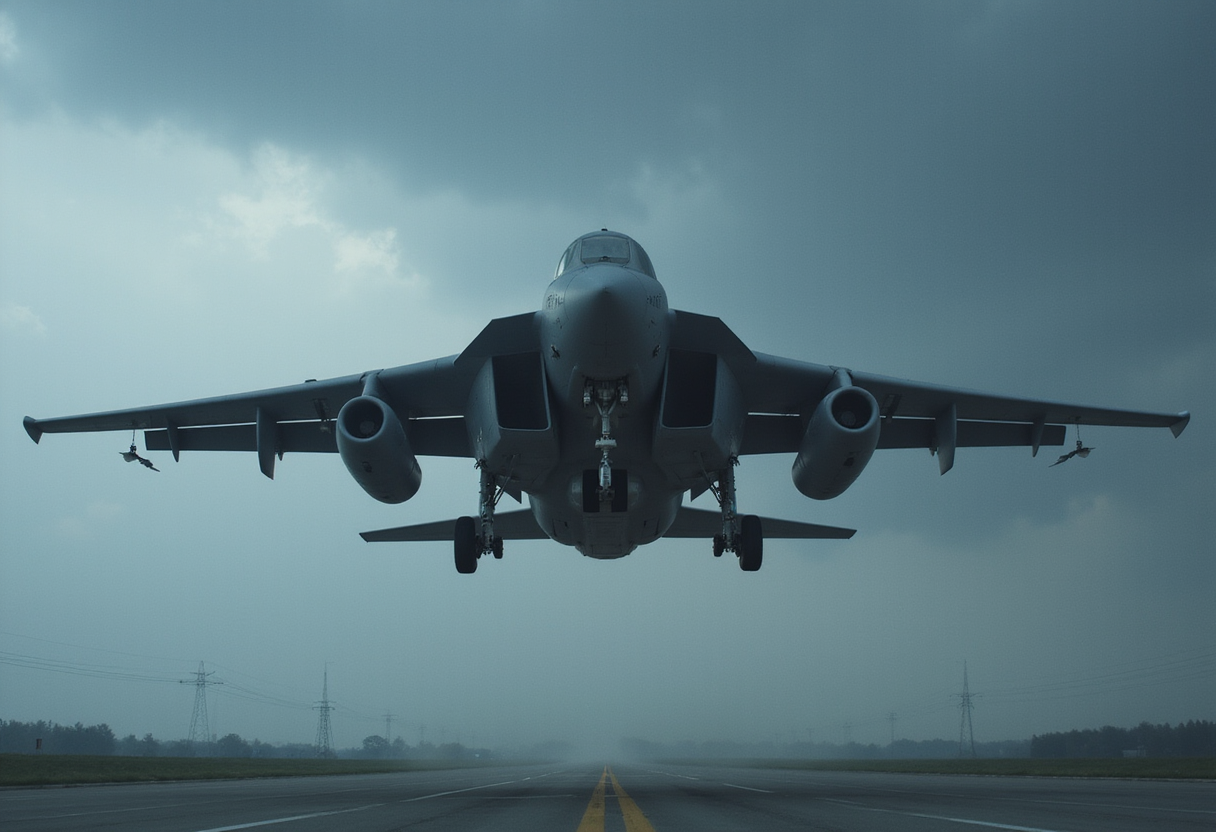
U.S. Transportation Command operates 52 C-5Ms and 223 C-17s — the exact figure validated by the last three Pentagon mobility studies — yet the usable fleet is already below the paper number: a hull loss reduced the C-17 count to 222, and one aircraft belongs to NATO's Strategic Airlift Capability. That shortfall, detailed in a 2026 Congressional Research Service study, is emerging before any question of political access enters the equation. Access, not airframes, is now the binding constraint on American mobility across Eurasia.
The mechanism is cumulative. Since 2022, airspace closures across Russia and the Gulf have been asymmetric — different airlines hold different political rights to the same geography — and persistent. Chinese carriers retained Russian overflight rights while Western operators lost them. In summer 2019, Chinese airlines flew roughly 55 percent of scheduled China–Europe capacity; by summer 2025 their share reached 83 percent, with total market capacity flat. Finnair's Helsinki–Tokyo flight time rose from about nine hours to 13, a 44 percent increase, after the carrier lost Russian transit.
The numbers quantify what analysts now call the "geopolitization" of Eurasian civil aviation. During the latest Middle East disruption, airlines rerouted 1,150 flights per day, burning 206,000 additional kilometers daily. On March 31, 2026, EUROCONTROL recorded 56 percent fewer flights between the Middle East and Europe after the Iran war closed Gulf airports and forced cancellations.
Concentration in the Caucasus
Traffic that once dispersed across northern Eurasia now funnels through the corridor between Russian airspace to the north and Iranian and Gulf airspace to the south. At one point the route narrowed to roughly 160 kilometers, with Georgia, Azerbaijan, Armenia and Turkey absorbing displaced flows. Azerbaijan's air navigation system handled about 278 flights a day at the start of 2022; by end-2025 the figure had more than doubled to 695, with annual overflights rising from 47,065 in 2021 to 261,085 in 2025.
Aircraft followed the same geography. Two Boeing 747-400 freighters formerly operated by Russia's Sky Gates left the country after repossession in late February 2022 and were re-registered in Azerbaijan within days, flying for Silk Way West Airlines between Baku, Europe and China.
Dubai illustrates the commercial stakes. The hub handled a record 95.2 million passengers in 2025, up 3.1 percent. Then the Iran war struck: first-half 2026 traffic fell 31.3 percent to 31.5 million passengers, with aircraft movements down 32.1 percent. With Russian airspace already unavailable to Western operators, the war disrupted the southern alternatives the network had come to depend on — a second geographic loss proving more consequential because the first had already concentrated the system.
Military mobility under compression
The Pentagon built its global lift capacity inside this civilian ecosystem and still depends on it. From 2009, the Northern Distribution Network moved military cargo across Russia and Central Asia into Afghanistan. Volga-Dnepr An-124s flew NATO strategic airlift missions; a 2009 U.S.-Russian agreement opened Russian airspace to American military aircraft including C-17s. By April 2011, more than 1,000 U.S. supply missions had transited Russia, carrying over 150,000 personnel.
That access is gone, and allied access has proven conditional too. Spain denied its airspace and bases to U.S. aircraft supporting strikes on Iran; fifteen U.S. military aircraft, mostly KC-135 tankers, relocated from Rota and Morón, with at least seven moving to Ramstein in Germany. Ahead of the Iran war in February 2026, the United States moved roughly 150 military aircraft into Europe and the Middle East. As U.S. Transportation Command commander Gen. Randall Reed put it in 2025: adversaries can now contest logistics "from point-of-origin to point-of-use," meaning the United States is "fighting to move, instead of moving to fight."
The Civil Reserve Airfleet compounds the tension. During the 2021 Afghanistan evacuation, 18 activated CRAF aircraft never flew into Kabul — civilian carriers retain operational control and can refuse missions on operational risk grounds. Separation from geopolitical rivals remains uneven: USTRANSCOM's May 2024 Unsuitable Vendor List included Air China Cargo, China Eastern and China Southern, yet Delta ended its China Southern codeshare only in 2025, while China Eastern remains a Delta partner and United maintains a codeshare with Air China.
Aircraft as geopolitical assets
Widebody freighter capacity itself has become contested. Boeing ended C-17 production in 2015 and delivered the final 747 in 2023; the Antonov An-124 fleet is similarly finite. More than a dozen AirBridgeCargo 747-8 freighters have spent years parked at Moscow Sheremetyevo, unrecovered by Western lessors despite litigation. BOC Aviation won a $406.2 million New York judgment against AirBridgeCargo yet also failed to recover its two 747-8s — until March 2024, months after Putin's October 2023 Beijing visit, when Russian authorities let the Bank of China-controlled lessor's aircraft leave. An English High Court judgment concluded China's "friendly" status likely enabled the return; Atlas Air subsequently put both freighters into U.S. service.
Demand for scarce capacity keeps rising. In 2025, more than two-thirds of the value of global trade in AI-related goods moved by air, with some AI server racks now requiring the 747's nose cargo door. An EU-funded study in September 2026 identified two options for Europe's outsized cargo fleet: deep modernization of Ukrainian An-124s or a new C-17 replacement.
USTRANSCOM leads the Joint Deployment and Distribution Enterprise and studies contested mobility, but the public debate still lacks a framework for cumulative geographic loss across multiple theaters. The relevant question is no longer whether the United States possesses 275 strategic airlift aircraft, but how much effective mobility that fleet can deliver if Russian airspace, Gulf hubs and major European or Asian hubs degrade simultaneously — a scenario Eurasia's narrowing corridors are already rehearsing.
via npr.org (Original)
More from Nathan Brooks
Show full bio
Correspondent covering media and advertising at Flightdeck Report.
172 articles
Same bay
- FDR518Finnair Says Chinese Carriers' Russian Airspace Access Skews Competition · September 30, 2026
- FDR280US carriers fight Air China's bid for extra Beijing flights · September 26, 2026
- FDR145US Carriers Resist New China Routes as Russian Overflight Ban Distorts Competition · September 27, 2026
- FDR104FAA Visit Ends as Kazakhstan Presses Bid for Direct US Routes · September 28, 2026
- FDR927FAA Wraps Five-Day Aviation Safety Assessment in Kazakhstan · September 28, 2026