Clearance CLR-9718 · AIR585
AIRETH
Air CargoClearance sheet
Ethiopian Airlines Orders Eight 777-8 Freighters, Two 777Fs
Ethiopian Airlines has committed to eight Boeing 777-8 Freighters and two 777Fs, deepening its cargo-led strategy and adding an African anchor to the 777-8F backlog.
Read-back
- Ethiopian Airlines ordered eight Boeing 777-8 Freighters and two current-generation 777Fs.
- The 777-8F remains in development; the newly ordered type will deliver only after certification and entry into service.
- The order consolidates Ethiopian's role as Boeing's leading freighter customer in Africa, built around the Addis Ababa cargo hub.
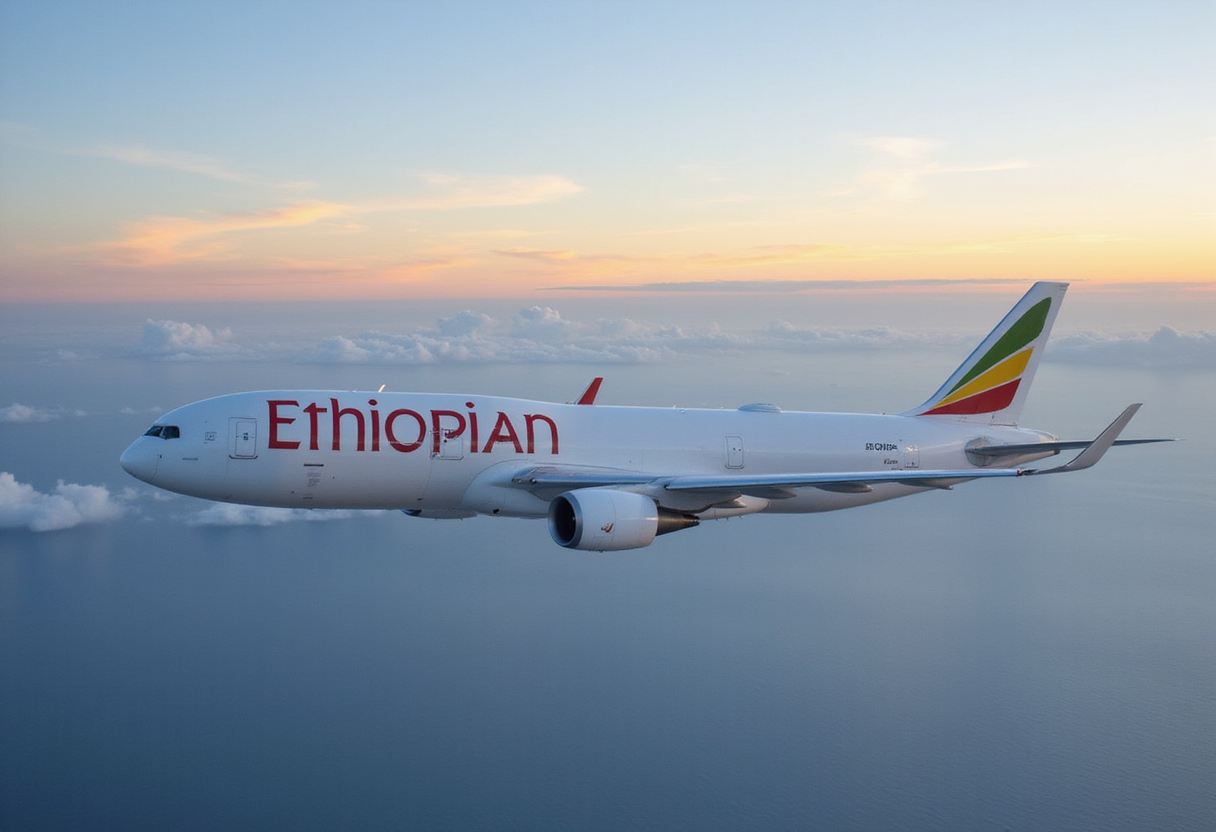
Ethiopian Airlines has ordered eight Boeing 777-8 freighters and two current-generation 777Fs, a ten-aircraft commitment that ranks among the most significant cargo fleet expansions by any African operator.
The order reinforces the Addis Ababa-based carrier's position as Boeing's most important freighter customer on the continent. Ethiopian already operates a substantial 777F fleet built around its Addis Ababa hub, which serves as a cargo gateway connecting Asia, Europe, the Middle East and the Americas with African markets.
The eight 777-8 Freighters place Ethiopian among the early customers for Boeing's next-generation widebody freighter program. The 777-8F, the cargo derivative of the 777X family, remains in development and has not yet entered service, meaning the newly ordered aircraft will join Ethiopian's fleet only after certification and first deliveries to launch operators. Boeing has not disclosed a delivery schedule tied to Ethiopian's order.
The two additional 777Fs, by contrast, are current production aircraft. That split signals a dual-track strategy: near-term capacity additions through the in-service 777F while securing future slots for the larger, longer-range 777-8F.
For Ethiopian, the commitment extends a cargo operation that has become central to the airline's business model. Cargo revenue has repeatedly proved more resilient than passenger income during demand shocks, and the airline has invested accordingly in freighter capacity, cargo terminal infrastructure at Addis Ababa Bole International Airport, and a network designed around transferring freight through the Ethiopian capital.
The order also carries weight for Boeing. The 777-8F program's backlog now draws support from a diversified base of cargo operators, and African demand — historically concentrated at Ethiopian — adds a growth market to a customer list otherwise anchored in North America, Europe, Asia and the Middle East. For Boeing's Everett production system, each freighter commitment helps underpin 777X-family output as passenger-variant deliveries continue to slip against original timelines.
Ethiopian's choice to stay with the 777 platform rather than commit to competing freighter products also consolidates fleet commonality benefits. The carrier's pilots, maintenance organization and spares provisioning are already built around the 777, and the 777-8F shares enough of the family's operational DNA to preserve much of that advantage.
How quickly the order translates into delivered metal depends on two variables outside Ethiopian's control: the pace of 777-8F certification and Boeing's ability to hold its freighter delivery schedule. The two 777Fs will add capacity sooner; the eight 777-8Fs will define the carrier's cargo capacity in the next decade.
via Google News: Air cargo (Source)
More from Sophie Lindqvist
Show full bio
Senior reporter covering industry trends and analytics at Flightdeck Report.
188 articles
Same bay
- FDR372Ethiopian Airlines to Acquire 10 Boeing 777 Freighters · October 1, 2026
- FDR948Ethiopian Adds Ten 777 Freighters, Becomes First African 777-8F Customer · October 1, 2026
- FDR880Ethiopian Airlines orders eight 777-8Fs and two 777Fs from Boeing · September 30, 2026
- FDR455Ethiopian Airlines commits to eight 777-8Fs and two 777Fs · September 30, 2026
- FDR220Ethiopian Airlines Expands Cargo Fleet With Additional Boeing Freighters · October 2, 2026