Clearance CLR-7139 · AIR194
AIRAFR
Air CargoClearance sheet
African Air Cargo Demand Rises 3% While Capacity Surges 14%: IATA
IATA data shows African air cargo demand up 3% against a 14% capacity jump, a gap that pressures load factors and yields across the continent's trade lanes.
Read-back
- African air cargo demand rose 3% while capacity grew 14%, per IATA
- Capacity expanded roughly 4.5 times faster than demand, pressuring load factors and yields
- Africa remains IATA's smallest cargo region, anchored by perishables exports to Europe
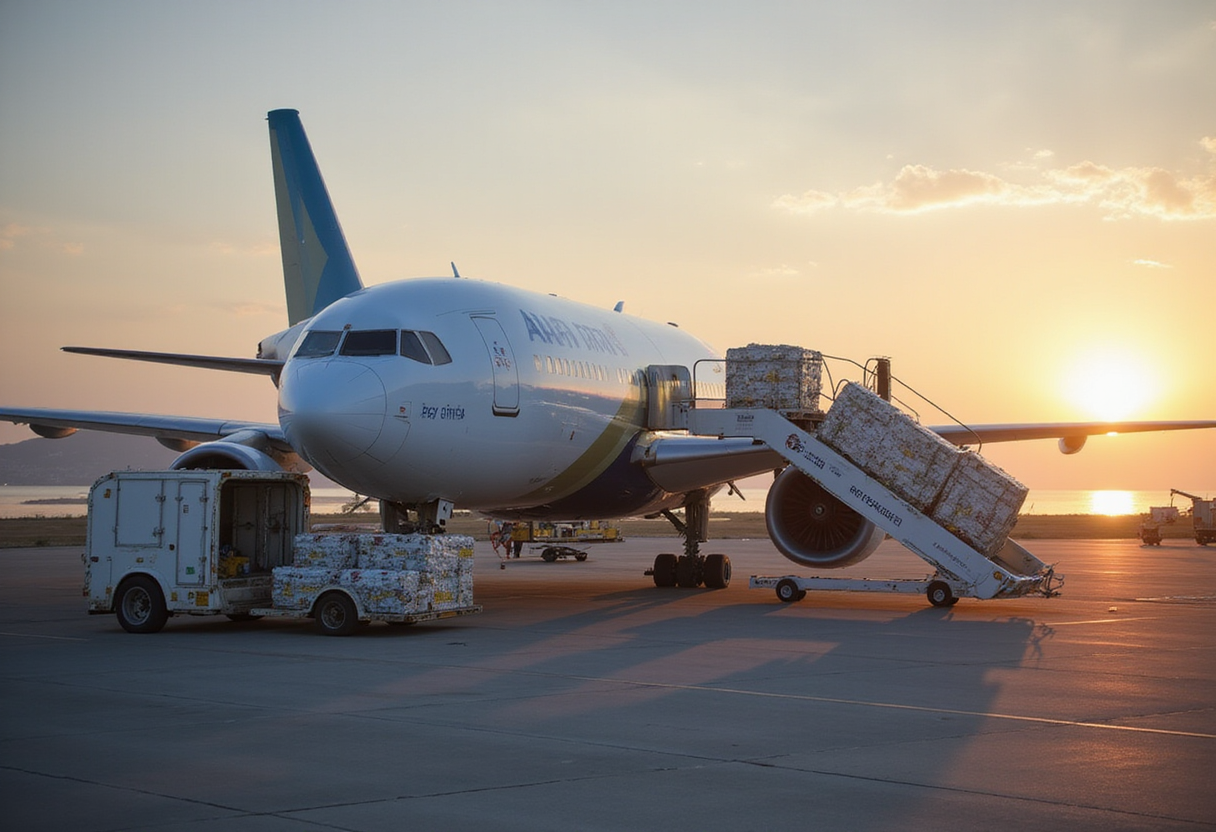
Africa's air cargo demand grew 3% while capacity on the continent jumped 14%, according to the latest figures from the International Air Transport Association (IATA) — a gap of more than four to one between the supply of freighter and belly capacity and the traffic actually carried.
The imbalance is the single most consequential number in the data. When capacity expands at roughly 4.5 times the rate of demand, load factors fall unless carriers can stimulate new traffic, and yields come under pressure across intra-African and Africa-linked trade lanes. For carriers that have bet on fleet expansion — adding freighter capacity or taking widebody belly space on passenger routes — the arithmetic is unforgiving.
IATA's regional cargo statistics are the industry's benchmark measure of chargeable weight carried and available cargo tonne-kilometres, compiled from airline reporting worldwide. Africa has long been the smallest of the association's regions by cargo volume, and the continent's freight market is shaped by a distinctive trade profile: heavy outbound flows of perishables — flowers, vegetables, fish — toward Europe, balanced against inbound shipments of manufactured goods, equipment and e-commerce consignments.
A 14% capacity increase suggests operators and their partners have added substantial lift over the period measured. Capacity in African cargo markets comes from three streams: dedicated freighters operated by carriers such as Ethiopian Airlines Cargo — the continent's largest cargo operator by fleet and network — belly hold space on widebody passenger services, and wet-leased or ACMI capacity positioned onto African routes by international operators. IATA's headline figure does not break down which of these streams drove the increase.
The 3% demand figure, meanwhile, indicates that trade volumes grew only modestly. For a region where air freight is often the only viable mode for time-sensitive and high-value exports, demand growth below the global inflation rate implies real volumes were close to flat.
The consequences will land unevenly. Carriers with strong niche positions in perishables and pharmaceuticals — traffic that is less price-elastic and more service-dependent — can defend yields better than operators competing on general cargo. Airlines that expanded capacity on the expectation of faster trade growth may now face the choice of absorbing lower load factors or redeploying aircraft to stronger markets.
For forwarders and shippers, the picture is more favourable. Abundant capacity and softening load factors typically translate into negotiating leverage on rates, at least on lanes where multiple operators compete. For airport cargo handlers and ground service providers across African hubs, higher capacity throughput with only marginal demand growth compresses margins on the ground as well as in the air.
The regional figures also matter for planning. Aircraft lessors evaluating placements in Africa, and OEM sales teams pitching freighter conversions and new-build freighters to African operators, will read a 3%-versus-14% split as a caution flag on the pace of further capacity additions — even as Africa's long-term air cargo fundamentals, driven by population growth, trade integration under the African Continental Free Trade Area and expanding e-commerce, remain among the strongest of any region.
IATA's next monthly releases will show whether African demand growth catches up with the capacity already in the market, or whether the continent's carriers face a sustained period of yield erosion.
via Google News: Air cargo (Source)
More from Priya Raman
Same bay
- FDR358African Airlines Post 3.0% Cargo Demand Growth in August · September 29, 2026
- FDR427African Air Cargo Capacity Grows 14% Against 3% Demand Rise · October 1, 2026
- FDR802Africa Air Cargo Demand Rises 3% in August as Capacity Jumps 14% · October 2, 2026
- FDR980Air Cargo Demand Grew 4.4% in August as Capacity Shrank · September 30, 2026
- FDR877Air Cargo Demand Grew 4.4% in August as Load Factor Reached 46% · September 30, 2026