Clearance CLR-6350 · AIR289
AIRETH
Air CargoClearance sheet
Ethiopian Airlines turns to Boeing freighters for cargo push
Ethiopian Airlines is adding Boeing freighters to its cargo fleet, becoming one of several carriers locking in dedicated capacity while global air-cargo supply stays tight. The initial announcement did not disclose aircraft type, quantity, or delivery timeline.
Read-back
- Ethiopian Airlines announced a cargo fleet expansion using Boeing freighters, with details carried by New Era Live
- The announcement did not specify aircraft type, unit count, delivery position, or financing structure
- Boeing's active freighter line consists of the 767-300F, built at Everett, and the 777F, produced alongside the 777 passenger program
- The 747-8F ended production in 2023, with Atlas Air taking the final airframe, removing that option from any new Ethiopian order
- Ethiopian Cargo already operates 777-200F freighters and has publicly targeted 1 million tonnes of annual cargo throughput
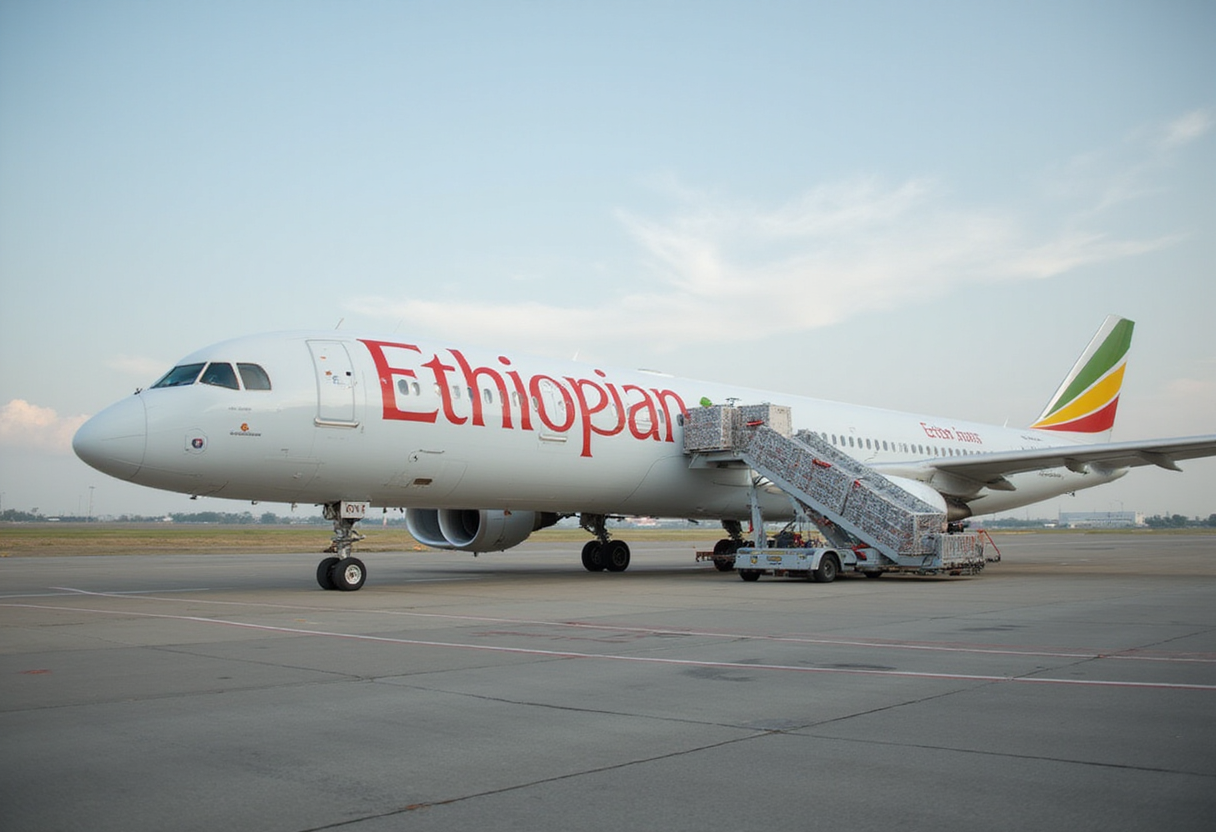
Ethiopian Airlines has launched an expansion of its cargo fleet with additional Boeing freighters, becoming one of several flag carriers locking in dedicated capacity while global air-cargo supply remains tight and belly-hold recovery lags pre-pandemic levels.
The Addis Ababa-based carrier, which operates one of Africa's largest air-cargo networks through its Ethiopian Cargo & Logistics Services subsidiary, did not disclose aircraft types, unit counts, or delivery slots in the initial report carried by Namibian outlet New Era Live.
What does Boeing still build as a freighter?
Boeing's commercial freighter catalogue has narrowed materially in recent years:
- 767-300F: in production at Everett, Washington, with the order book dominated by Amazon Air and FedEx Express
- 777F: shares a production system with the 777 passenger program; major operators include Lufthansa Cargo, Qatar Airways Cargo, and Emirates SkyCargo
- 747-8F: production ended in 2023, with Atlas Air taking the final airframe
Any Ethiopian commitment therefore most likely involves the 767-300F or 777F, since no 747-8F slots remain available from Boeing. Ethiopian Cargo already operates 777-200F aircraft, which would make a 777F follow-on the more probable candidate for incremental units. A 767-300F selection would instead represent a return to a smaller payload category the carrier has not operated in dedicated configuration for some time.
What does the deal mean for Ethiopian's network?
Ethiopian Cargo runs scheduled and charter services from its Addis Ababa Bole International hub. Pharma handling, perishable expertise, and e-commerce uplift have driven recent volume growth, and the carrier has publicly targeted 1 million tonnes of annual cargo throughput — a benchmark additional freighters would directly support.
Addis Ababa's geographic position, combined with Ethiopian's African trunk network and long-haul Asia-Europe services, gives the carrier a structural advantage connecting flows between Asian manufacturing hubs and African consumer markets. New freighters would extend payload into routes where passenger belly capacity is insufficient or unavailable, particularly on narrow-body sectors the carrier has historically addressed through converted 737 freighters.
How does this fit Boeing's backlog picture?
Boeing's commercial order book remains under close investor scrutiny following the 737 MAX crisis, the January 2024 Alaska Airlines mid-exit incident, and slower 787 output. Freighter demand has been a relative bright spot, with the 767-300F line sold out for several years and the 777F program running at low single-digit monthly rates.
A new flag-carrier commitment from a marquee African operator would reinforce the demand side of that equation. Counter-pressure comes from Airbus, which is positioning the A350F against the 777F for certification and entry into service, and from converted-freighter operators including AerCap, Avolon, and GECAS affiliates, all of which are expanding their portfolios to capture demand from integrators and e-commerce platforms.
What remains unanswered?
The New Era Live report does not specify:
- Aircraft variant
- Unit count
- Order status (firm contract vs. commitment vs. LOI)
- Financing structure
- Engine selection
Until Ethiopian Airlines publishes a fuller statement, the headline value of the deal — whether measured in aircraft, dollars, or strategic positioning — cannot be independently assessed. Airline announcements on freighter acquisitions are routinely followed by amended orders or revised delivery slots, and investors typically look to subsequent Boeing order disclosures for confirmation.
The carrier's next scheduled commentary on fleet and capacity strategy will determine whether the Boeing commitment expands into a multi-aircraft program or represents a narrower addition to the existing cargo fleet. Watch for updated Boeing order and delivery tables in the coming weeks to gauge the scale of what Addis Ababa has placed on top of its current freighter roster.
via Google News: Air cargo (Source)
More from Priya Raman
Same bay
- FDR585Ethiopian Airlines Orders Eight 777-8 Freighters, Two 777Fs · October 2, 2026
- FDR372Ethiopian Airlines to Acquire 10 Boeing 777 Freighters · October 1, 2026
- FDR610Ethiopian takes African launch for 777-8F with 10-aircraft Boeing order · October 10, 2026
- FDR546Ethiopian Adds 10 Boeing 777 Freighters, Takes First African 777-8F Slot · October 10, 2026
- FDR948Ethiopian Adds Ten 777 Freighters, Becomes First African 777-8F Customer · October 1, 2026