Clearance CLR-2621 · AIR998
AIRFLY
Airspace & RegulationClearance sheet
flydubai FZ1073 hijack attempt triggered Israel's two-point airspace protocol
Flydubai flight FZ1073 transmitted a distress signal on September 30, 2026, well outside Israeli airspace, after a crew stabbing. The activation moved PM Netanyahu, the defense minister, IDF chief of staff and IAF commander onto one conference call.
Read-back
- Flydubai flight FZ1073 transmitted a distress signal on September 30, 2026, well outside Israeli airspace, after a pilot was stabbed
- The aircraft diverted to Saudi Arabia before a replacement flydubai plane completed the route to Ben-Gurion International Airport later that day
- Every inbound commercial flight must identify itself at two staged checkpoint points before reaching Israeli airspace
- Prime Minister Benjamin Netanyahu holds sole authority to order the shoot-down of a civilian aircraft under the protocol
- The replacement flight carried 175 passengers who had boarded FZ1073 in Dubai
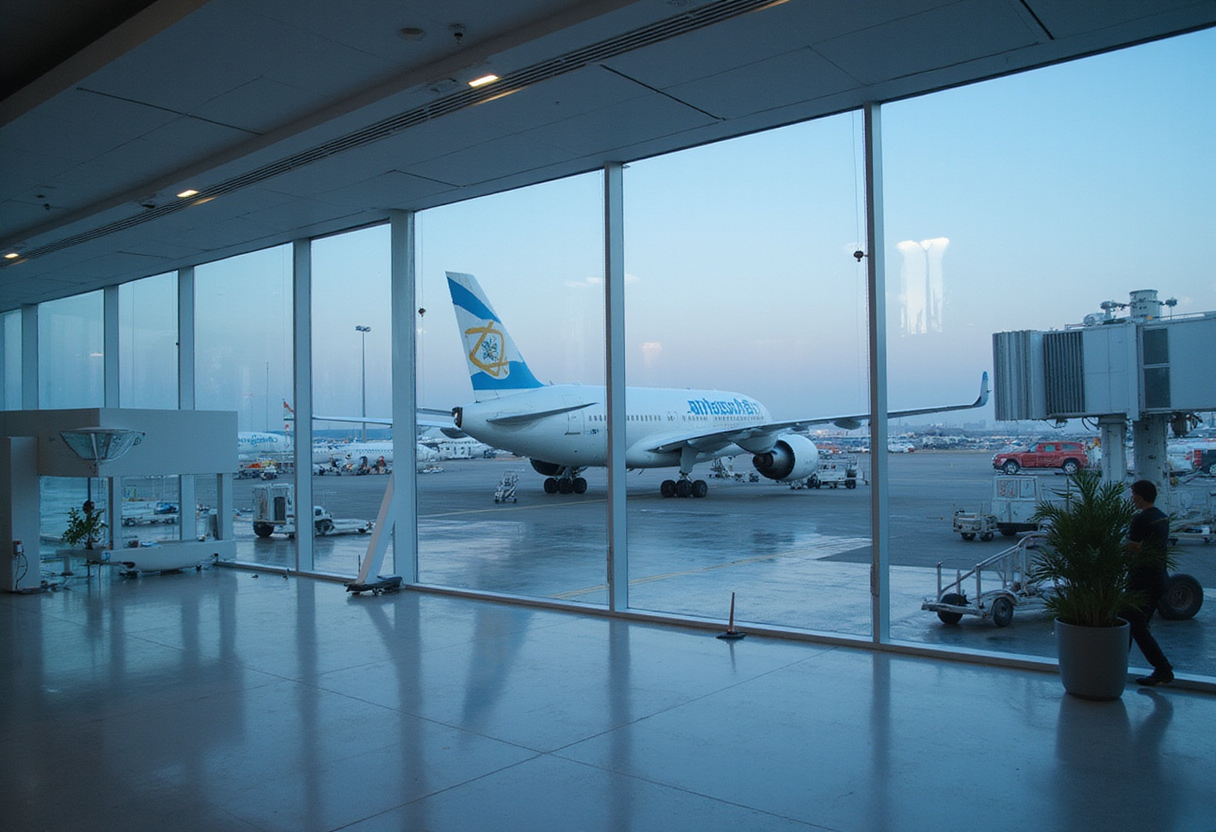
Flydubai flight FZ1073, en route from Dubai to Tel Aviv, transmitted a distress signal on September 30, 2026, well outside Israeli airspace, after a crew member was stabbed. The aircraft diverted to Saudi Arabia for an emergency landing. A replacement flydubai plane carried the same passengers on to Ben-Gurion International Airport later the same day.
The signal activated Israel's full inbound-aircraft security chain. Shin Bet dispatched a team to Dubai to coordinate the return flights, The Jerusalem Post reported.
What is the two-point identification system?
Every commercial flight entering Israeli airspace encounters two staged identification points at fixed distances from the border:
- Outer point: allows a pilot to begin approach toward Israeli airspace.
- Inner point: permits continued transit toward a landing inside Israel.
At each point, the crew transmits a pre-arranged code to Israeli air traffic control. The code validates the aircraft's authorization and permits. The Israel Defense Forces positions the outer point far enough out to give fighter jets reaction time if a pilot misses identification or signals an emergency.
What triggers a fighter scramble?
A failure to identify at the outer checkpoint, or any indication of an unusual incident onboard, sets the scramble process in motion.
Scrambling does not carry an automatic shoot-down instruction. Aircraft communication systems fail, leaving crews unable to reach controllers. In those cases, Israeli fighters attempt contact using procedures familiar to both sides, with particular emphasis on visual contact.
How do crews communicate visually?
Before any inbound flight, the captain asks passengers to open window shades. That action lets escorting fighter pilots look into the cabin and cockpit from each side of the aircraft and observe what is happening inside.
Airline crews also know standardized visual hand signals to convey onboard conditions. Radio and discrete distress buttons supplement those signals. Standardized pre-departure procedures buy time at altitude, allowing the Israel Air Force to move through monitoring, identification, examination, verification and, in the most extreme case, interception before any decision to use force.
Who decides to shoot down a civilian aircraft?
The prime minister holds sole authority.
"The prime minister has to be on the line. He makes the decision," a former senior Israel Air Force officer told The Jerusalem Post.
All parties take the call directly, not through aides. The conference call links Benjamin Netanyahu, the defense minister, the IDF chief of staff and the IAF commander. Briefings on available information precede the final call.
The trade-off is framed in raw numbers: "There is a difference between shooting down a passenger aircraft with 175 passengers and a civilian aircraft with 175 civilians crashing into the Azrieli Towers with a thousand people killed," the former officer said. "That is why, from the moment the planes are scrambled, the prime minister is on the line."
What coordination followed the hijack attempt?
Shin Bet dispatched officers to Dubai to coordinate return flights, and the replacement flydubai aircraft arrived at Ben-Gurion on September 30 once the airport's security procedures completed.
The Israel Air Force treats the protocol as a timed drill. All involved agencies "are drilled for a scenario of this kind down to a matter of minutes, in order to carry out a precise process in response to an airborne terrorism scenario," the former officer said.
The drill-based architecture that brought Netanyahu, the defense minister, the IDF chief of staff and the IAF commander onto one line within minutes now counts FZ1073 as its most recent real-world test, and Israeli aviation authorities will fold the lessons back into the next scheduled airspace exercise.
via payments.jpost.com (Original)
More from Grace Kim
Show full bio
News editor covering consumer brands and retail at Flightdeck Report.
350 articles
Same bay
- FDR283Flydubai 737 MAX 8 Diverts to Tabuk After 7500 Squawk · September 30, 2026
- FDR854Flydubai FZ1073 Cockpit Attack Exposes Insider-Threat Gap · October 3, 2026
- FDR482Israel Prepared to Down flydubai Jet in Reported Hijack Attempt · October 9, 2026
- FDR153Flydubai hijack scare refocuses attention on Israel's aviation security regime · October 10, 2026
- FDR915Flydubai halts Israel flights after 737 cockpit assault on FZ1073 · October 10, 2026