Airspace & RegulationClearance sheet
House China Committee Wants FAA to Block Chinese Aircraft Certification
The House Select Committee on China wants the FAA to refuse certification of Chinese-made aircraft and to strip US contracts from firms investing in China — with Airbus and its Tianjin operations squarely in the frame.
Read-back
- A congressional report described by Reuters on November 19, 2026 urges the FAA to refuse certification of Chinese-made aircraft
- Airbus opened a second A320-family final assembly line in Tianjin in October 2025; the original 2008 line has delivered over 780 aircraft
- Committee Chairman John Moolenaar's December 2025 letter singled out Xi'an Aircraft Industry Group, which makes A320 wings and develops Chinese military aircraft
- The committee's November 13, 2026 report found the C919 still lacks FAA and EASA certification and relies on Western engines and avionics
- The proposed contract restrictions would require government action before taking effect
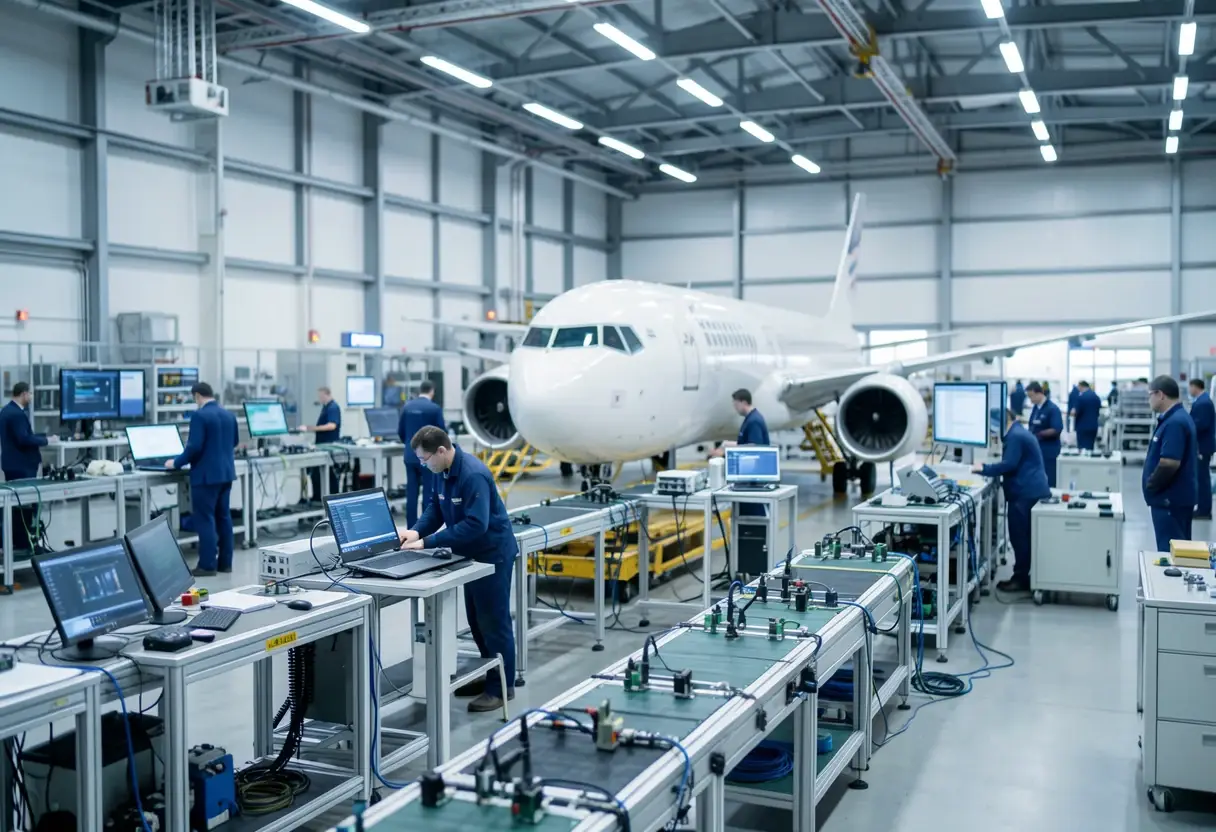
A congressional committee has urged the Federal Aviation Administration to refuse certification of Chinese-made aircraft and called for stripping US government contracts from aerospace companies that keep investing in China — a set of recommendations aimed squarely at Airbus and its deepening manufacturing footprint in Tianjin.
The push landed as President Donald Trump wrapped up summit talks with Chinese President Xi Jinping, a timing that put industrial policy at the edges of a diplomatic encounter. The House Select Committee on China argues that Western aerospace partnerships have helped strengthen China's military, according to a congressional report described by Reuters on November 19, 2026. Airbus is among the companies targeted by the proposed contract restrictions.
Nothing takes effect immediately. The recommendations would require government action — legislation, executive measures or regulatory decisions — before any contract is pulled or any certification application is rejected. For now, the report is a signal of where a powerful committee wants US policy to go, not a change in law.
Why Airbus is in the frame
This is not the first time the European manufacturer's Chinese operations have drawn scrutiny from Capitol Hill. In a December 2025 letter to Defense Secretary Pete Hegseth, committee Chairman John Moolenaar questioned whether Airbus's Chinese partnerships were helping companies involved in military aircraft production.
The letter singled out Xi'an Aircraft Industry Group, a supplier with a double life. Xi'an manufactures A320 wings for Airbus's Tianjin operation and, separately, develops Chinese military aircraft. The committee's argument is about capability transfer rather than technology theft: commercial manufacturing work gives those companies skills, processes and industrial capacity that can be useful to military programs.
Moolenaar also accused the French government of obstructing the inquiry. His letter said Paris was controlling what Airbus could disclose to foreign authorities — while noting that Airbus itself had appeared willing to cooperate. That distinction matters for a manufacturer caught between a legislative subpoena in Washington and a state shareholder in Paris.
The Tianjin expansion at the center of it
The commercial facts underpinning the committee's concern are concrete. Airbus opened a second A320-family final assembly line in Tianjin in October 2025, under an agreement with the Tianjin Free Trade Zone Investment Company and Aviation Industry Corporation of China — AVIC, the state-owned parent of much of China's military aviation industrial base.
Airbus framed the expansion in production terms: the additional line would help it increase output and serve customers in China and elsewhere. The original Tianjin line, opened in 2008, had assembled and delivered more than 780 A320-family aircraft by the time the second line came online. That is not a token presence — it is nearly two decades of accumulated narrowbody deliveries flowing through a joint venture structure the committee now wants to treat as a liability.
The stakes run in both directions. For Airbus, Tianjin is a capacity pillar in the world's largest single-country aircraft market, and unwinding it would carry real cost and delivery consequences. For US policymakers, the question is whether market access and supply-chain entanglement in China constitute a strategic transfer — and whether contract restrictions could be enforced without collateral damage to American operators, lessors and suppliers tied to the same ecosystem.
What the committee found about Chinese aerospace
The contract recommendations sit alongside a separate piece of work. On November 13, 2026, the committee published a report examining China's commercial aircraft industry. Its findings cut both ways.
The review described extensive government support for domestic manufacturers — the subsidies, state direction and protected demand that have built COMAC into a serious industrial project. But it also concluded that China remains behind Western competitors in aerospace, and the specifics explain why.
COMAC's C919 narrowbody, the flagship of that effort, still relies on Western engines and avionics. It lacks certification from both the FAA and the European Union Aviation Safety Agency. Those approvals remain decisive for the aircraft's prospects beyond China: without them, the C919 is confined, in practice, to the domestic market.
The committee's own framing captures the paradox at the heart of US policy. Chinese airlines provide a large captive domestic market for the C919, which means the aircraft can survive and scale without Western certification. Meanwhile, the FAA refusal the committee recommends would formalize exactly that bifurcation — two certification regimes, two aircraft markets, and an increasingly separate supply chain on each side.
What happens next
The recommendations now sit with the executive branch and Congress. If contract restrictions advance, Airbus would face a choice between its US government business and its Tianjin industrial base — a decision with knock-on effects for A320-family capacity, Chinese airline deliveries and the suppliers clustered around both. If the FAA formally hardened its posture on Chinese certification, the C919's already narrow path to Western markets would close further.
For now, neither has happened. What has changed is that the demands are on paper, attached to a committee with a record of turning letters into legislation, and aimed at an OEM whose second Tianjin line is barely a year old.
via reuters.com (Original)
More from Nathan Brooks
Show full bio
Correspondent covering technology and product news in Commercial aviation industry coverage at Flightdeck Report.
700 articles
Same bay
- Boeing Secures Major China Aircraft Order After Trump-Xi Summit · October 10, 2026
- Boeing shares climb on report of imminent China aircraft order · October 10, 2026
- Beijing Confirms Boeing Aircraft Order Following Trump's Visit · October 10, 2026
- Boeing shares climb on report of expected China aircraft order · October 10, 2026
- Boeing Shares Rise on Expected China Aircraft Order · September 27, 2026