AirportsClearance sheet
SITA launches Border Flow to speed Asia-Pacific border processing
SITA claims Border Flow can pre-clear 75% of travelers before departure and process them up to eight times faster, as Asia-Pacific airports seek more capacity without expanding.
Read-back
- SITA launched Border Flow as a commercial product on September 9, 2026.
- SITA claims up to eight times faster processing than traditional e-gates, with 75% of travelers cleared before departure.
- A SITA biometric program at more than 22 airports cut terminal-to-gate time from around 40 minutes to under seven.
- SITA’s Baggage IT Insights report found a 23% reduction in mishandled baggage during 2025; the industry still incurs about $6.3 billion annually.
- Automatic bag rebooking reduced one implementation from about three minutes of manual work to one second.
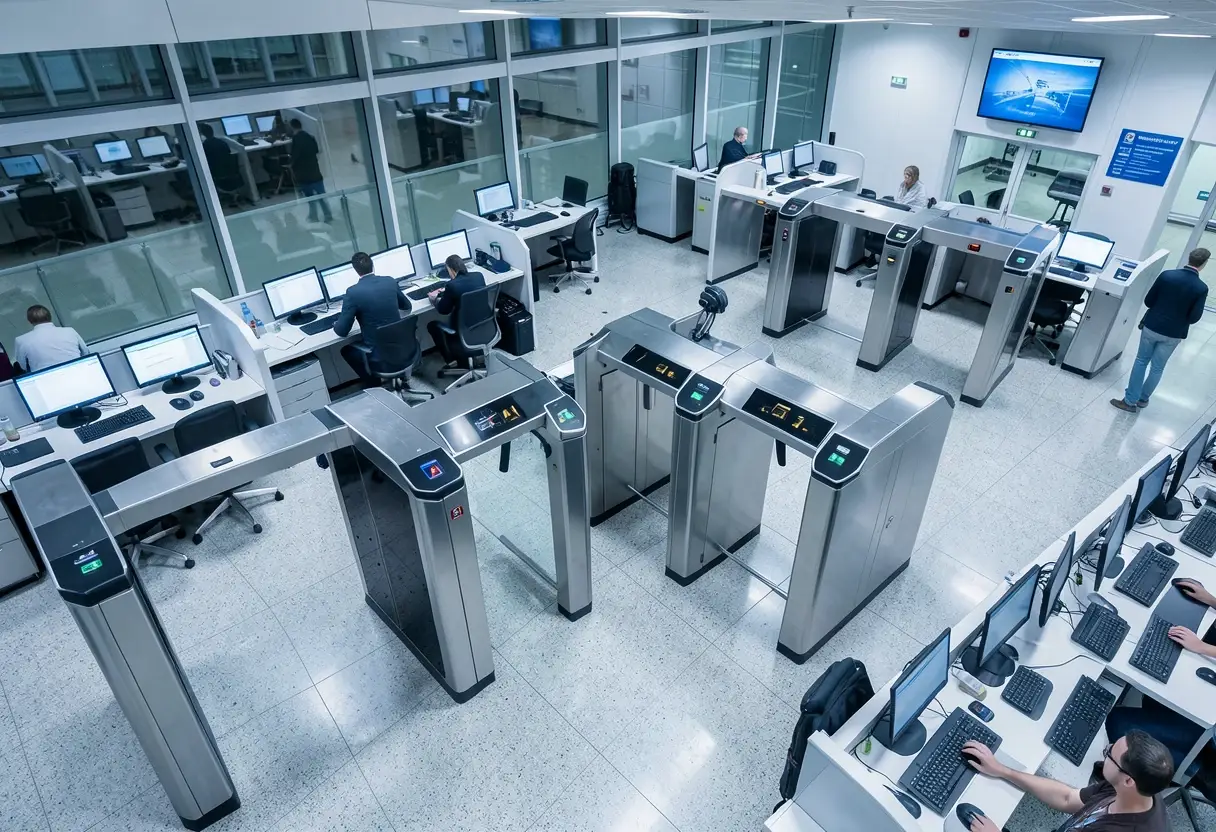
SITA launched Border Flow commercially on September 9, 2026, claiming it can process travelers up to eight times faster than traditional e-gates and clear 75% before departure.
The claim has no independent validation here. SITA, the air transport IT provider, names no airport, border agency or regulator as a confirmed Border Flow operator.
At Passenger Terminal Expo Asia 2026 in Singapore, Sumesh Patel, SITA’s Asia-Pacific president, described a region expected to generate almost half of future world passenger growth. Airports cannot double their footprint to match demand, he said.
Patel framed the planning horizon as up to 10 billion passengers a year. SITA’s answer: process passengers, bags and borders faster within existing space, while moving more of the journey away from the airport.
Patel said the expo’s first Asian edition reflected where growth was heading. He also said the event was busier than expected.
Border processing moves upstream
Border Flow follows years of trials at SITA’s customer experience center in Singapore. The system pre-clears passengers before they reach the airport, allowing them to walk through border control without stopping. It also removes queues at gates and counters. Immigration officers can focus on “the people of interest rather than stopping everyone,” Patel said.
Commercial launch does not mean regional deployment. SITA is discussing pilots and trials with several unnamed Asia-Pacific airports and border agencies. No confirmed operating site, regulatory sign-off or independent throughput test appears in the account.
Patel expects Asia-Pacific to move faster than other regions because of its lead in biometrics and pressure from growing fleets and passenger numbers. He said airports have no choice but to rely more on technology. In his view, the fastest adopters need not have the newest equipment. Close cooperation sets the pace: agencies must change processes and work as one.
What does this change for airport operators?
For airport operators, the immediate change is process sequencing, not a new terminal.
SITA has implemented a biometric program at more than 22 airports. Patel said the time from entering the terminal to reaching the gate fell from around 40 minutes to under seven.
SITA does not name the participating airports or explain the measurement method. Until the company publishes airport-level results, operators should treat the figures as reported case outcomes rather than a regional benchmark applicable directly to their own terminals.
Kobe Airport shows the physical constraint. SITA helped the Japanese airport expand into international operations without building a new terminal. It integrated passenger-processing technology, including self-service check-in. The same systems now support domestic and international operations.
Patel said the aim was to leverage existing infrastructure rather than rebuild another terminal. Kobe can add international service without a terminal project, although SITA gives no capital or operating-cost saving. Capacity would come from using the footprint more intensely, but the promised gain remains unquantified.
Baggage data targets disruption costs
SITA’s latest Baggage IT Insights report found that technology helped reduce mishandled baggage by 23% in 2025. The interview does not identify which deployments produced the reduction or the comparison baseline.
Baggage mishandling still costs the industry about $6.3 billion a year. Patel expects the problem to persist as passenger numbers and fleets grow.
SITA is working with Apple and Google on a service that lets passengers share an item tracker’s location with an airline or ground handler. Item trackers spread during the pandemic, but travelers previously lacked an easy way to pass location data onward. Patel identified the missing step: giving airlines and handlers usable information.
SITA also introduced automatic rebooking of delayed bags onto the next available flight. In one recent implementation, the process fell from about three minutes of manual work to one second without human intervention.
SITA gives no airport, airline, exception rate or wider performance distribution for that case. The $6.3 billion annual cost makes the proposition material, but the evidence remains one implementation rather than an industry-wide result for airport operators to test now.
One operating picture for each airport
Patel identified passenger experience and airport operations as the two main opportunities. His operations proposal starts with fragmentation. Ground handling, gate allocation, vehicle movements and aircraft movements often work in isolation. SITA’s airport management system aims to combine those feeds into a “single source of truth” shared with every stakeholder.
For an airline operation, a flight arriving 30 minutes late could otherwise leave cleaning, catering and baggage teams waiting at the gate. Integrated data lets those teams reassign their time and helps the airport manage disruption more effectively.
That promise depends on data quality, interoperability, common operating rules and timely handoffs, none of which the example documents or quantifies at participating airports today. Patel’s central point was that collaboration, not technology alone, sets the pace.
Passenger processing should also move upstream, from check-in to baggage drop. Patel said much of the terminal work can now happen before travelers arrive, allowing airports to process more passengers through the same infrastructure.
For SITA, the strategy means moving more of the journey online and giving airport partners the same operating data. His conclusion was blunt: “It’s not a question of technology. The technology is there.”
That leaves the burden of proof with named deployments, audited times, staffing effects and disruption outcomes. Until those appear, Border Flow is a commercially launched product with claimed benefits, not a proven regional capacity solution. The practical test is whether airports and border agencies can change processes together.
via AeroTime (Source)
More from James Calloway
Show full bio
Staff writer covering people, launches and day-to-day practice in Commercial aviation industry coverage at Flightdeck Report.
734 articles
Same bay
- US$2.4 Trillion Airport Bill Meets a Volatile Demand Curve · November 13, 2026
- SATS deploys autonomous cargo vehicles at Changi Airfreight Centre · September 28, 2026
- Taiwan commits NT$19 billion to air traffic control overhaul · October 20, 2026
- Singapore Changi reports resilient passenger and cargo demand · October 19, 2026
- Asia-Pacific carriers carried 33.5 million passengers in August, down 0.6% · September 28, 2026