Clearance CLR-7989 · AIR136
AIRCAR
Airspace & RegulationClearance sheet
Carriers hold Saudi airspace routing as regional war escalates, AGBI reports
Arabian Gulf Business Insight reports that airlines continue overflying Saudi Arabia despite a regional escalation, though the brief names no carriers, lists no city pairs and quantifies no traffic volumes.
Read-back
- AGBI reported airlines continue flying through Saudi Arabian airspace despite a regional escalation
- The AGBI brief did not name carriers, list routes or quantify traffic
- Saudi airspace connects European hubs with South Asia, Southeast Asia and East Africa markets
- AGBI's dispatch did not identify whether GACA has issued new NOTAM guidance
- Cirium and FlightRadar24 publish real-time Saudi overflight counts that could quantify the trend
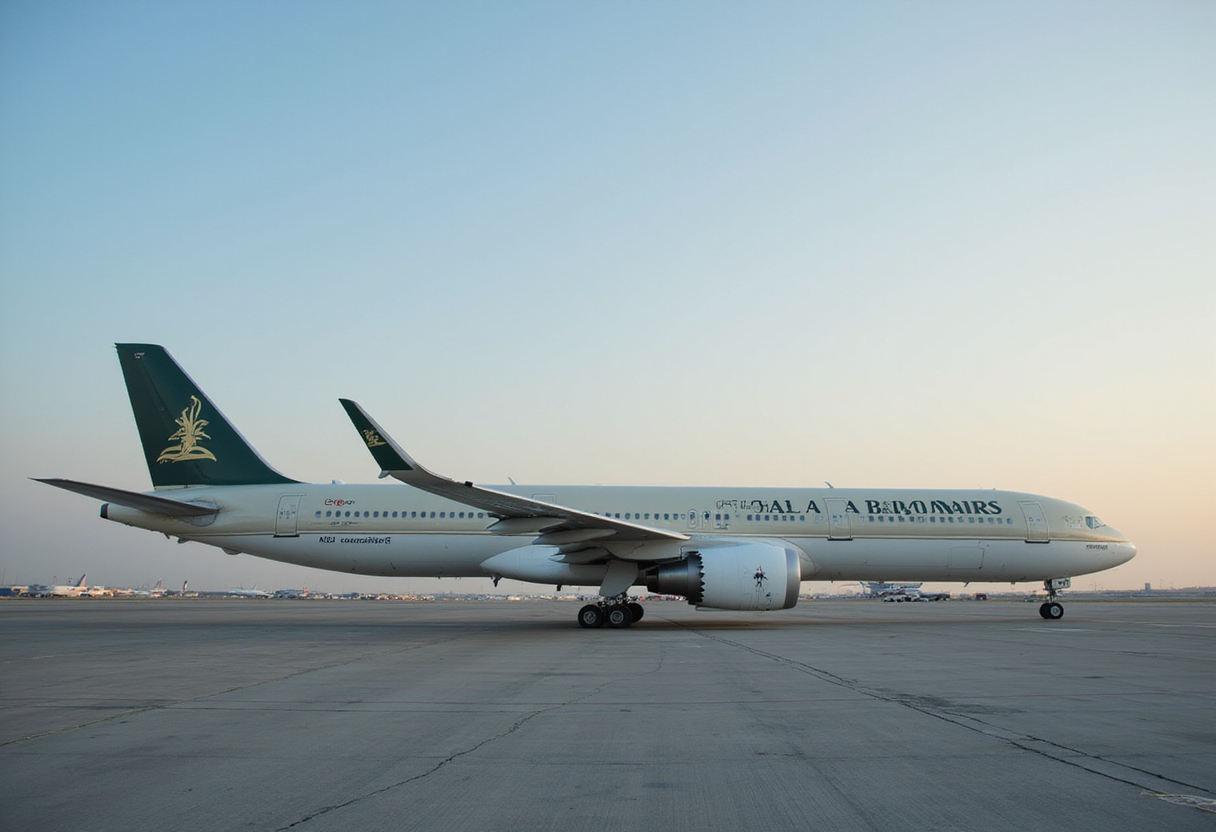
Arabian Gulf Business Insight has reported that commercial airlines continue to fly through Saudi Arabian airspace despite a fresh escalation of regional hostilities. The brief from AGBI carried no named operators, no route list and no flight-count data, leaving the precise scale of the continued overflights unspecified.
Saudi territory sits across some of the world's most-used long-haul corridors, linking European hubs with destinations in South Asia, Southeast Asia and East Africa. The kingdom's geographic position makes its airspace a structural component of east–west airline networks, and any extended closure would force carriers into longer routings around the Arabian Peninsula, through Iranian airspace or via the Caucasus. The operational fallout runs through block times, fuel burn and crew scheduling — and ultimately ticket pricing on Gulf, South Asian and Southeast Asian city pairs.
What does the AGBI brief actually establish?
The headline fact is straightforward: airlines are flying through Saudi airspace while a war-related escalation is underway. AGBI's published dispatch did not detail the conflict's nature, the magnitude of the escalation or the identity of carriers still using the routings. Operational decision-makers therefore lack a granular picture of which operators have continued, which have rerouted, and whether any have suspended service altogether.
The reporting also stops short of confirming whether the Saudi General Authority of Civil Aviation (GACA) has issued any new operational directive, or whether the escalation falls inside Saudi borders or in adjacent airspace used by Gulf-flag hubs.
How do carriers normally respond to airspace risk?
Industry practice in such episodes follows a familiar sequence. Airlines monitor NOTAMs from GACA and equivalent regulators, consult ICAO advisories, and review war-risk insurance pricing from underwriters at Lloyd's of London. When premia cross thresholds set in each carrier's operating policy, or when a government formally closes territory, fleets reroute.
Past episodes of regional tension have produced analogous patterns. European-flag carriers, historically more conservative on Middle East routings under EASA territorial advisories, have at times diverted around affected territory, while Gulf operators — Emirates, Qatar Airways, Etihad and Saudia — typically maintained fuller service through their home region. That asymmetry reflects network geometry as much as risk appetite: Gulf hubs sit inside the conflict geography, so withdrawing overflights would also cut access to the hub bank itself.
What remains unverified?
Because AGBI's reporting does not name airlines, list affected city pairs, or cite regulatory text, several operational questions stay open:
- Whether GACA has issued new NOTAM guidance restricting overflights
- Whether carriers have received quiet directives from home regulators to avoid Saudi corridors
- The volume of commercial traffic still transiting the kingdom's flight information regions
- The specific theatres of the "escalation" the report references
Tracking platforms such as Cirium and FlightRadar24 routinely publish real-time counts of Saudi overflights that would, in principle, resolve the volume question within hours. Until quantified data becomes available, the report carries only directional weight.
What comes next?
If the security situation deteriorates further, the expectation inside airline operations control centres is straightforward: carriers will route around any formally closed segment, insurers will reprice, and tickets already issued on Gulf, South Asian and Southeast Asian routes will face schedule disruption.
Saudi Arabia's centrality to east–west traffic means even a partial closure produces non-trivial network effects for connecting banks at hubs in Dubai, Doha and Riyadh — and for the European carriers whose Indian and Asian services depend on the corridor.
For now, AGBI's reporting establishes only that the corridor remains in use. Everything past that point waits on the next bulletin from GACA, the next dispatch from operational data feeds, or the first confirmed reroute advisory from a major airline operations control.
via Google News: Air traffic control and airspace (Source)
More from Grace Kim
Show full bio
News editor covering consumer brands and retail at Flightdeck Report.
350 articles
Same bay
- FDR967Houthis warn airlines against using Saudi airspace · October 10, 2026
- FDR628EASA Warns Airlines to Avoid Parts of Saudi Airspace · October 1, 2026
- FDR701EASA widens Saudi airspace warning after Houthi airport attack · October 9, 2026
- FDR301Houthi Warning Against Saudi Airspace Reshapes Airline Risk Calculus · October 10, 2026
- FDR181EASA warns airlines to avoid parts of Saudi airspace · September 30, 2026