Clearance CLR-3640 · SAF883
SAFSOU
Safety & OperationsClearance sheet
South Africa's Airline Fleet Is Ageing — and Maintenance Is the Metric That Counts
South Africa's airline fleet is ageing, but maintenance discipline — not an aircraft's manufacture date — determines airworthiness, reliability and the economics of keeping older jets flying.
Read-back
- South Africa's commercial airline fleet is ageing, putting maintenance practices under scrutiny
- Aircraft age alone is not a reliable indicator of airworthiness; maintenance quality determines safety
- Older fleets carry rising maintenance costs — gear overhauls, engine shop visits and structural checks — that affect reliability if deferred
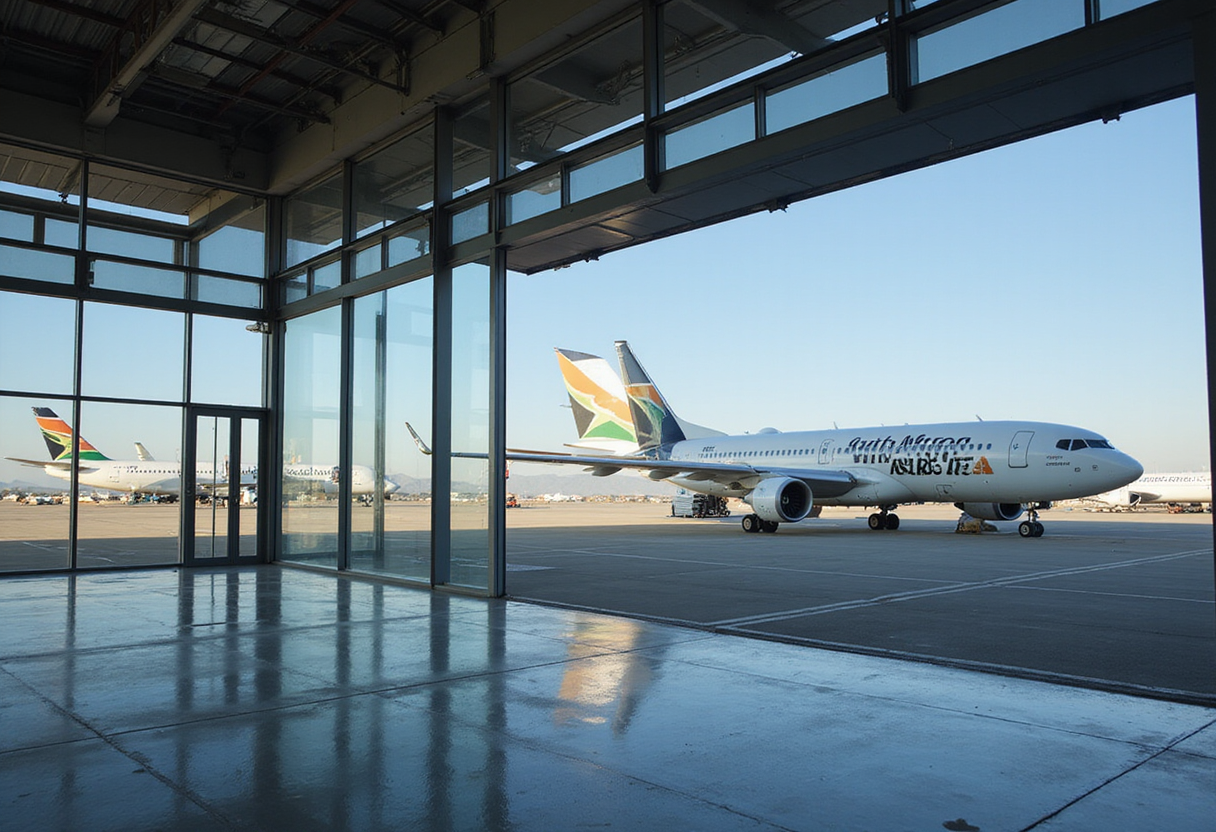
South Africa's commercial airline fleet is getting older, and the conversation around that reality is shifting from birthdays to maintenance records. The question that matters for passengers, regulators and operators is not how many years an airframe has logged, but how rigorously it has been maintained throughout those years.
That distinction sits at the centre of the discussion prompted by a recent Eyewitness News examination of the country's ageing airline fleet. The report's core proposition is straightforward: an aircraft's chronological age is a poor proxy for its airworthiness. What determines whether a 25-year-old narrowbody is safe to board is the quality, depth and consistency of the maintenance regime behind it — not the manufacture date printed on its data plate.
This is not an abstract argument. Aircraft are engineered for long service lives, and airframes routinely fly for two, three, even four decades when they pass through well-run maintenance programmes. Regulators worldwide, including South Africa's civil aviation authority, mandate scheduled inspections, component replacement intervals and structural checks that escalate as an aircraft accumulates flight cycles. A well-maintained older jet can meet the same airworthiness standards as a new one. A poorly maintained young one cannot.
For South African carriers, the stakes are both operational and economic. New aircraft are expensive and, in the current market, slow to obtain, with global backlogs at the major manufacturers stretching delivery timelines years into the future. Keeping older types flying is often the only viable way to sustain capacity on domestic and regional routes. That choice is defensible — but only if it comes with sustained investment in maintenance, spare parts and technical expertise.
The maintenance burden grows with age, and it grows in specific, predictable ways. Landing gear overhauls, engine shop visits, structural inspections around fatigue-critical areas, and the replacement of ageing wiring and systems components all become more frequent and more costly as aircraft mature. Operators that defer or shortcut this work face consequences that go far beyond safety concerns: dispatch delays, cancellations, aircraft on ground events, and the steady erosion of schedule reliability that passengers experience directly.
This is where the distinction between a safe fleet and a struggling one becomes visible to the travelling public. An airline can operate an old fleet flawlessly if its engineering organisation is funded, staffed and disciplined. It can also operate a young fleet into the ground. Fleet age statistics, often cited in discussions of airline quality, tell only part of the story. Maintenance culture tells the rest.
South Africa's aviation sector has particular reason to focus on this question. The industry has weathered airline failures, currency pressure that inflates the cost of imported parts and new aircraft, and competition that squeezes the margins available for heavy maintenance spending. In that environment, the temptation to stretch maintenance intervals or defer non-critical work is real. Regulators and auditors exist precisely to police that temptation, and the country's oversight record will matter more as its fleet ages.
Passengers, for their part, can take a measured view. An older aircraft from an airline with a strong maintenance reputation and effective regulatory oversight is not inherently riskier than a new one. The indicators worth watching are operational: on-time performance, cancellation rates, and the transparency with which carriers and the regulator handle technical issues when they arise.
The broader lesson from the ageing-fleet debate applies well beyond South Africa. Across global aviation, carriers are flying aircraft longer than the industry once considered typical, and the safety record shows that age, managed correctly, is compatible with high reliability. What the record also shows is that the management is the hard part — requiring money, expertise and institutional discipline sustained over decades, not marketing reassurances.
As South African carriers continue to operate some of the oldest aircraft in their fleets for the foreseeable future, the quality of their maintenance programmes, and the strength of the regulatory oversight behind them, will do more to determine the safety of the country's skies than any birth certificate in the hangar.
via Google News: Aircraft orders and fleets (Source)
More from James Calloway
Show full bio
Staff writer covering industry trends and analytics at Flightdeck Report.
156 articles
Same bay
- FDR576Fleet Age and Safety: What Newer Aircraft Mean for Airlines · September 30, 2026
- FDR239Fleet Age and Safety: What Newer Aircraft Actually Deliver · September 26, 2026
- FDR283Industry order backlog tops 17,000 aircraft for first time · September 30, 2026
- FDR750ATR pitches US regionals on three-class 72-600 with forward boarding · September 26, 2026
- FDR728Uganda Airlines places first Boeing order with eight-jet deal · September 30, 2026