Clearance CLR-9846 · AIR227
AIRMIA
AirportsClearance sheet
MIA keeps two runways closed after 21 Air 767 overrun kills five
Two of four runways at Miami International remain closed after a 21 Air Boeing 767-300 overrun killed five people Sunday. FedEx and DHL say cargo schedules are normal, but reduced runway capacity is compounding delays for perishables and pharma.
Read-back
- Five people died in the Sunday overrun of MIA Runway 30 by a 21 Air Boeing 767-300 operating as Flight 7598 for Amazon Prime Air.
- Two of MIA's four runways remained closed as of Tuesday with no reopening date set pending NTSB scene documentation.
- FlightAware recorded 181 cancellations and 408 delays at MIA on Monday.
- MIA handled 3.4 million tons of air cargo in 2025 and ranks No. 5 globally by cargo tonnage, with 85% of volume international and 87% on freighter aircraft.
- FedEx and DHL both reported cargo operations at MIA have returned to normal after three DHL aircraft diverted to alternate airports on Sunday.
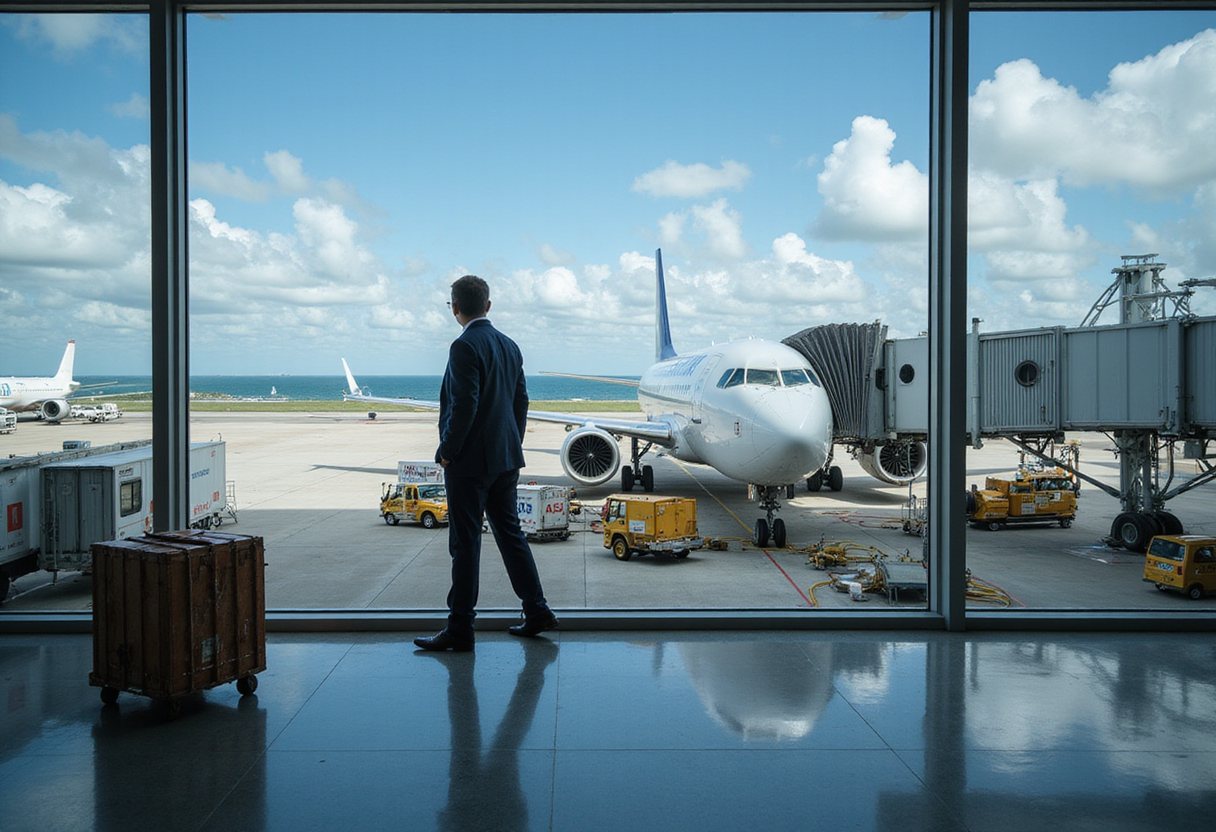
Five people died when a Boeing 767-300 freighter operating as 21 Air Flight 7598 for Amazon Prime Air overran Runway 30 at Miami International Airport (MIA) on Sunday, the Miami-Dade Sheriff's Office said. Two of MIA's four runways remained closed as of Tuesday, with no reopening date set.
The aircraft had arrived from San Juan, Puerto Rico. NTSB investigators were still documenting the wreckage on Monday, and Chairwoman Jennifer Homendy told reporters the site "is not a completely safe scene" yet for the agency.
"We hope that we can move through it swiftly because we know it is impacting flight operations here, but we have to make sure that we're able to get access to the aircraft first," Homendy said.
What does the closure cost MIA's cargo network?
FlightAware logged 181 cancellations and 408 delays at MIA on Monday alone. FedEx Express told Supply Chain Dive its MIA schedule is "operating as normal," and DHL Express said its network has "since returned to normal operations" after three MIA-bound DHL aircraft diverted to alternate airports when the airport temporarily closed on Sunday.
Widebody cargo flights to and from Latin America have restarted, but reduced runway availability is producing longer arrival holds and missed connections, according to Derek Lossing, founder of Cirrus Global Advisors.
Which shipments face the most exposure?
Lossing warned that downstream pressure will build fastest on cold-chain and time-critical freight. MIA handled 3.4 million tons of air cargo in 2025, ranking fifth globally by tonnage in the Airports Council International's latest list, with perishables, pharmaceuticals, e-commerce and high-tech goods the leading commodity groups. About 85% of that volume is international, and 87% moves on freighter aircraft rather than in passenger bellies.
"One delayed arrival can affect several downstream flights and distribution commitments," Lossing said. "Perishables, pharmaceuticals and other temperature- or time-sensitive shipments face the greatest immediate exposure."
He added that ground handlers at MIA "can only shift labor slightly," so late-arriving widebodies will create "backlogs and full warehouses" that compress processing capacity for sensitive cargo.
How long before operations normalize?
Lossing framed the recovery as a branching scenario. A short runway closure would mostly translate into 24-to-72-hour delay and backlog recovery. A closure stretching into multiple days would compound through missed connections, spoilage risk, additional trucking and repositioning costs, and higher charter and recovery pricing.
Either way, crews, aircraft rotations and maintenance schedules need "at least several days" to stabilize at the airport, Lossing said. The bottleneck is procedural rather than operational: until the NTSB releases the runway, MIA is running with half its arrival and departure capacity. Normalizing that constraint sets the pace for the rest of the network.
MIA sits at the center of U.S.-Latin America air cargo flows. FedEx completed a major expansion of its MIA hub in 2021 to add U.S.-Canada-Latin America-Caribbean capacity, and A.P. Moller-Maersk opened a dedicated Miami air cargo operation in 2024 aimed at Latin American connectivity. Both networks now absorb the schedule friction from a single Boeing 767 overrun.
The NTSB's investigation timeline will determine whether MIA's disruption remains a short-tail delay event or escalates into a multi-day capacity problem for perishables and pharma moving through the No. 5 global cargo gateway.
via techtarget.com (Original)
More from Sophie Lindqvist
Show full bio
Senior reporter covering industry trends and analytics at Flightdeck Report.
396 articles
Same bay
- FDR999Amazon Suspends Operations of 21 Air After Miami Runway Excursion · September 30, 2026
- FDR869Amazon suspends 21 Air after freighter overruns Miami runway · October 9, 2026
- FDR688NTSB: Amazon Air jet crossed half of Miami runway before fatal landing · October 2, 2026
- FDR799Amazon Halts Flying with 21 Air After Miami Cargo Crash · October 9, 2026
- FDR962Victims Identified in Fatal Amazon Prime Air Cargo Crash · September 27, 2026