Clearance CLR-2509 · SAF576
SAFNTS
Safety & OperationsClearance sheet
NTSB Finds Learjet 60 Elevator Pieces Miles From Florida Crash Site
NTSB investigators recovered most of a Learjet 60's left elevator up to 3.8 miles from the Florida crash site, confirming in-flight tail separation before the fatal dive.
Read-back
- Three pieces of the left elevator were found 1.3–3.8 miles from the crash site near Greenacres, Florida.
- The Learjet 60 crashed on November 1, 2026, killing both pilots and all seven passengers.
- The crew declared an emergency less than 30 seconds after a climb to 37,000 feet was approved, then reported an overspeed.
- Dashcam still frames appear to show the jet missing its entire horizontal stabilizer before impact.
- Investigators have not confirmed whether a cockpit voice recorder was aboard the accident flight.
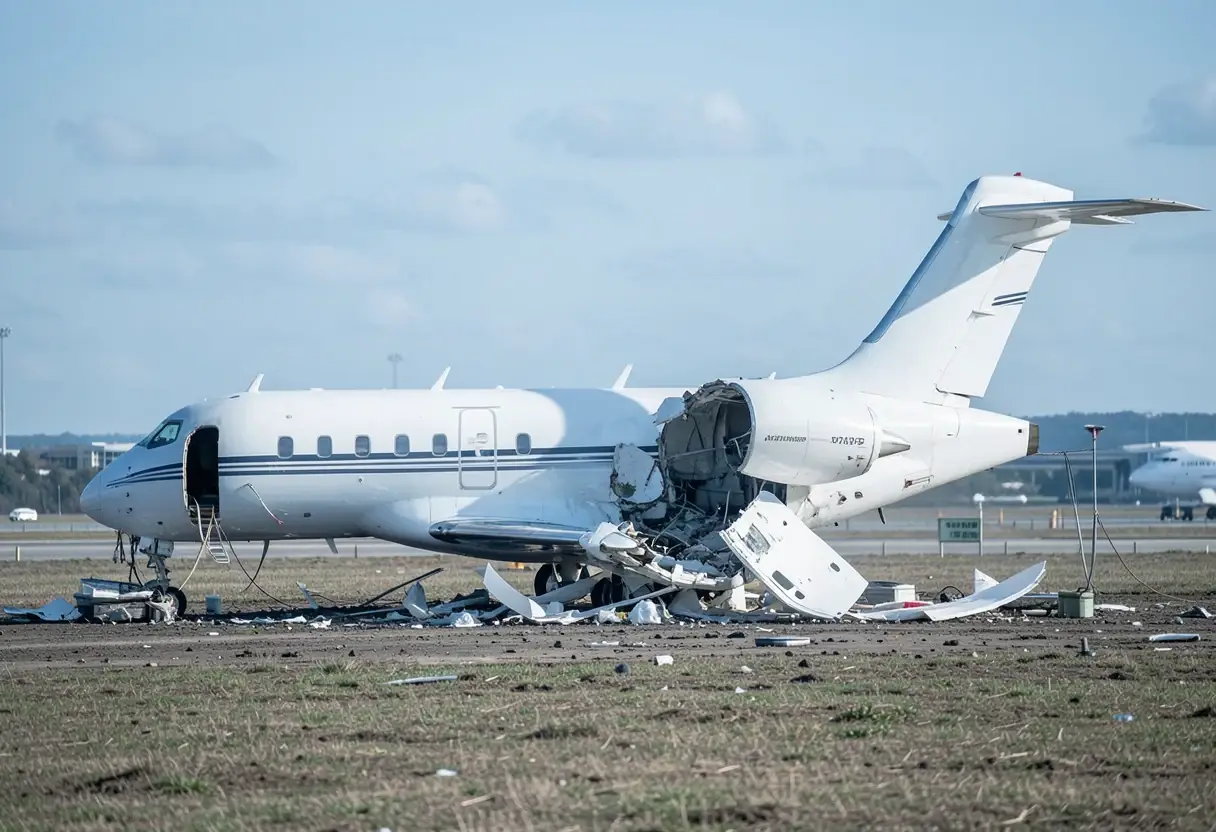
Investigators have recovered three pieces of a Learjet 60's left elevator between 1.3 and 3.8 miles from the impact site on South Military Trail near Greenacres, Florida, confirming that part of the aircraft's tail separated in flight before the November 1, 2026 crash that killed all nine people aboard. National Transportation Safety Board (NTSB) member Tom Chapman said at a November 3 briefing that the fragments account for most of the left elevator, the movable control surface on the horizontal stabilizer used for pitch control.
The discovery anchors the early factual record of an accident sequence that unfolded over roughly three minutes from cruise altitude. Chapman was direct about the consequence of losing the surface: the crew would have been unable to pull the Learjet out of its dive without the elevator intact. "At those speeds I don't know that it would've been effective even if it had still been attached to the aircraft," he said.
What does the evidence show so far?
Dashcam footage captured moments before impact adds weight to the in-flight-breakup finding. Still frames from the video show the Learjet apparently missing its entire horizontal stabilizer, the fixed tailplane to which elevators attach. Asked about the stabilizer at a November 2 briefing, Chapman said investigators already had evidence of an in-flight breakup. Whether the entire stabilizer separated remains a focus of the investigation.
The flight path reconstruction comes from crew radio calls to air traffic control. Aurora Aviation operated the charter flight from Austin-Bergstrom International Airport (AUS) in Texas to North Eleuthera (ELH) in the Bahamas. At about 12:47 local time, the Learjet was at 35,000 feet when the crew reported light clear icing and moderate turbulence. The pilots described the ice as manageable but told controllers the jet was deviating from its assigned altitude by about 700 feet.
The crew then reported precipitation and requested a climb to 37,000 feet. Less than 30 seconds after the controller approved the climb, the crew radioed that the aircraft was descending and declared an emergency. At about 12:48, the crew reported an overspeed — the aircraft exceeding its maximum permitted speed. The jet struck the road roughly three minutes later.
What remains to be recovered?
Site conditions have slowed the wreckage examination. Crews had to pump water from the impact crater before investigators could reach the main wreckage. Palm Beach County Commissioner Joel Flores said a broken water main and heavy rain impeded the work.
Among the items investigators hope to recover is a cockpit voice recorder. Chapman said maintenance records showed a recorder had been installed, but investigators were still establishing whether it was aboard for the accident flight. Its recovery would give the NTSB direct evidence of crew coordination during the final three minutes.
Who was aboard?
The crash killed both pilots and all seven passengers. Austin technology entrepreneur Adam Robinson, 45, and his wife, Helen Sharp, 40, were traveling with their two young children. The other passengers were the children's nanny, Ana María Ramírez Cetina, 24, and family friends Rowan Charmi Fehr Toews and Rachael Reed, both 38. The flight crew comprised Captain Jeffrey Gregory, 55, and First Officer Nathalia Gadelha Filgueiras, 20.
The sequence now documented — icing and turbulence reports, an altitude deviation, a climb request, an emergency declaration within 30 seconds, an overspeed report and a structural separation — frames the questions the NTSB must answer next: the order in which control was lost and structure failed, and what role the icing conditions played. Whether the cockpit voice recorder can be located and read may determine how much of that answer comes from evidence rather than reconstruction.
via AeroTime (Source)
More from Priya Raman
Show full bio
Market editor covering money, funding and market shifts around Commercial aviation industry coverage at Flightdeck Report.
558 articles
Same bay
- FDR989NTSB Finds Evidence of In-Flight Breakup Before Florida Learjet 60 Crash · November 2, 2026
- FDR262Nine Killed as Learjet 60 Dives Into Palm Beach County Neighborhood · November 2, 2026
- FDR772Nine Dead as Learjet 60 Lost With Icing Report Over Florida · November 2, 2026
- FDR334Learjet Crew Called Mayday 30 Seconds After Icing Report · November 5, 2026
- FDR921BFU: Vietnam Airlines 787-9 Braked Twice During Munich Takeoff Overrun · September 29, 2026