Clearance CLR-1662 · SAF863
SAFFAA
Safety & OperationsClearance sheet
FAA Ground Stop: How Flight Crews Manage a Nationwide Halt
The FAA has lifted its nationwide ground stop, but crews aloft had to manage the halt with backup radios and data link, says former captain John Cox.
Read-back
- The FAA lifted its nationwide ground stop after halting departures earlier today while airborne flights continued.
- O'Hare and Reagan National reported shortages of ground space for arriving aircraft during the stop.
- Crews relied on backup frequencies and ACARS/CPDLC data link to stay informed.
- Investigators will look for commonality across en-route centers, since the system is designed against single-point failure.
- Some airborne holding at congested major airports was authorized after the initial continue-to-destination instruction.
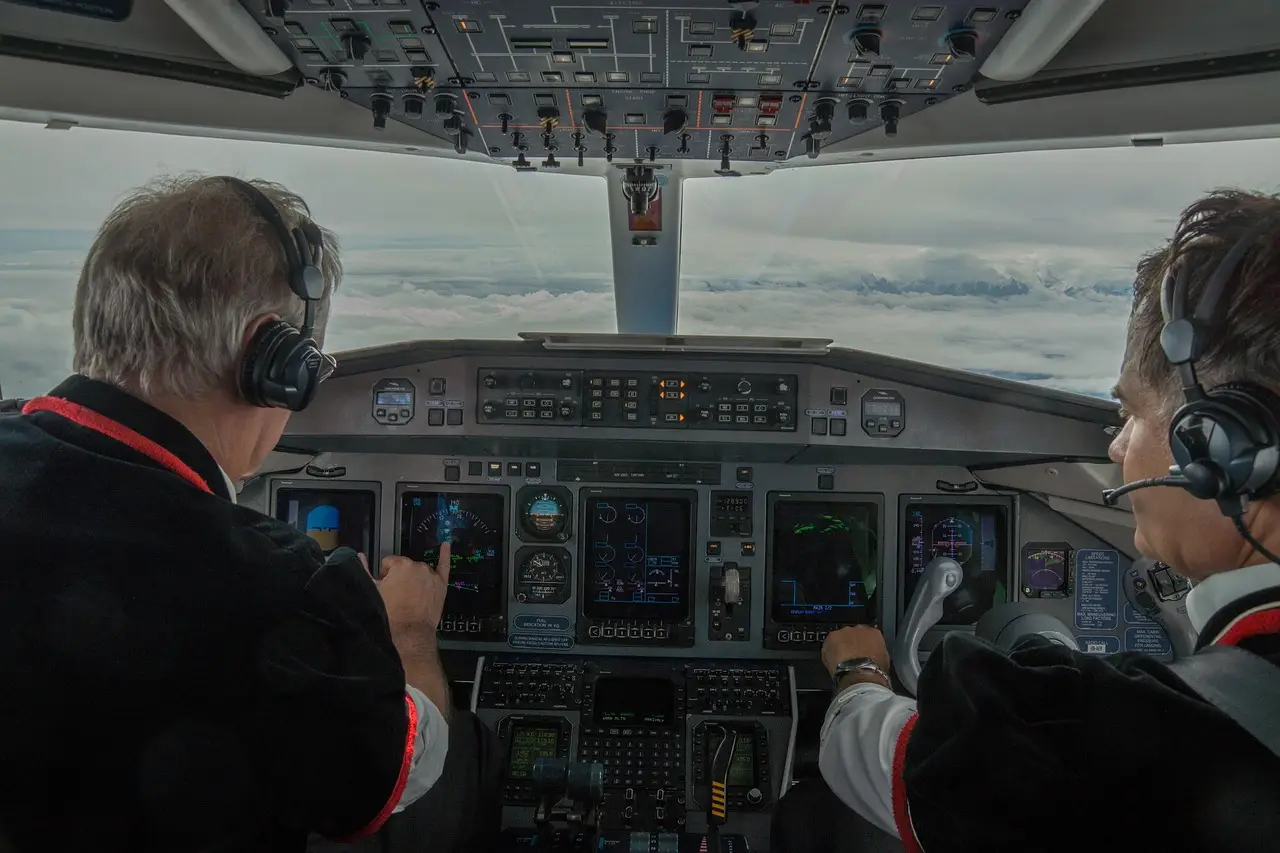
The FAA has lifted its nationwide ground stop, but while the halt was in force earlier today, aircraft already airborne continued flying — and crews had to manage the situation with very little information, at short notice.
John Cox, a former commercial airline pilot and aviation safety consultant, walked through the cockpit workload in an interview conducted while the stop was still active. His first priority, he said, would be keeping communication alive: "Let's try to find out what we can do to stay in communication. There are backup frequencies. There are other pilots that we can talk to."
Cox also pointed to data link as a lifeline. "I'm going to look for data link capability through a system known as ACARS or CPDLC (airborne text-messaging systems linking crews with controllers and dispatch) and see if I can get the necessary information via data link," he said. "So there's several redundancies built into the system."
Were airborne aircraft ever at risk?
No diversion order comparable to 9/11 — when aircraft were forced down at the nearest available airport — was issued this time. Cox read that as deliberate. "They've said very specifically that the aircraft that were en route were going to continue to their destinations," he said.
The FAA later amended that instruction, he noted, allowing airborne holding at the busiest hubs. The constraint is physical, not security-related. "One of the things that is becoming an increasing issue is the physical ground space to put the airplanes," Cox explained, warning that diversions remained possible where arrival airports could not absorb parked aircraft.
With departures largely stopped, arriving traffic stacked up. Two airports Cox named as short on ramp space were Chicago O'Hare and Reagan National in Washington. The bottleneck, in his framing, is not keeping aircraft separated but landing them somewhere with apron capacity to handle them.
How did the failure spread?
Asked what might have triggered a nationwide halt while en-route traffic kept moving, Cox declined to speculate. "As any good investigator will tell you, in the early hours, the thing you want to do is gather evidence," he said.
The puzzle, he argued, is architectural. The US air traffic system "is designed not to have a single-point failure," yet the incident produced "a cascading of issues." Investigators, he predicted, would hunt for the common thread: "Where's the origin of that? How did it proliferate from one en route traffic control center to another?"
Cox sketched the normal rhythm of controller-pilot communication to show how unusual a multi-center problem is. In cruise, contact can be sparse — a handoff to the next sector (a subdivided block of airspace) sometimes comes 8, 10, 15 or 20 minutes after the last exchange. Over a busy hub, by contrast, the flow is near-continuous, with 15 aircraft on one frequency and one of them talking to a controller at almost any moment.
What does a captain tell passengers?
Cox said he would keep a cabin announcement factual and calm. "I think I would explain it that we are experiencing some issues with the air traffic control system, that there are contingencies in place, and we are following them," he said.
The guarantee he would offer is procedural: "We are guaranteed separation from other aircraft by following those procedures." The honest cost, he added, is time — "things are going to be slower, and they're going to be slower once we get on the ground at our destination." His closing line to passengers: sit back, be patient, and let the system work as designed.
What are the open questions?
Cox listed three lines of inquiry. First, technical: "Is it something that is new? Is there a new system that's been implemented? Are there common areas for fiber optic cables?" — in short, any shared infrastructure that could explain one fault crossing center boundaries.
Second, operational: how the FAA command center reached its decisions, reviewed as a lessons-learned exercise. Third, and in his view the most important: "How do we put the system back together?"
Those questions now sit with the FAA as the agency restores normal traffic flow and begins establishing what a system built to resist single-point failure actually allowed to cascade.
via feeds.npr.org (Source)
More from Sophie Lindqvist
Show full bio
Senior reporter covering people, launches and day-to-day practice in Commercial aviation industry coverage at Flightdeck Report.
646 articles
Same bay
- FDR711Overloaded routers triggered nationwide US ground stop · November 14, 2026
- FDR203FAA Lifts Nationwide Ground Stop After Four-Hour Communications Failure · November 14, 2026
- FDR332FAA lifts second nationwide ground stop since September 11 · November 14, 2026
- FDR651FAA Nationwide Ground Stop Halts US Departures, Cancels Nearly 5,000 Flights · November 14, 2026
- FDR987Four-Hour FAA Ground Stop Grounds Thousands of Flights Nationwide · November 14, 2026